IMF cuts 2026 world growth forecast, citing Iran war fallout
The International Monetary Fund has trimmed its 2026 global growth forecast to 3 percent — down from 3.1 percent projected in April — marking the second downward revision this year.
Xavier Pennington, Lead Columnist, Systems & Macro-Trends·updated July 09, 2026
A Fragile Chokepoint Underpins the Downgrade
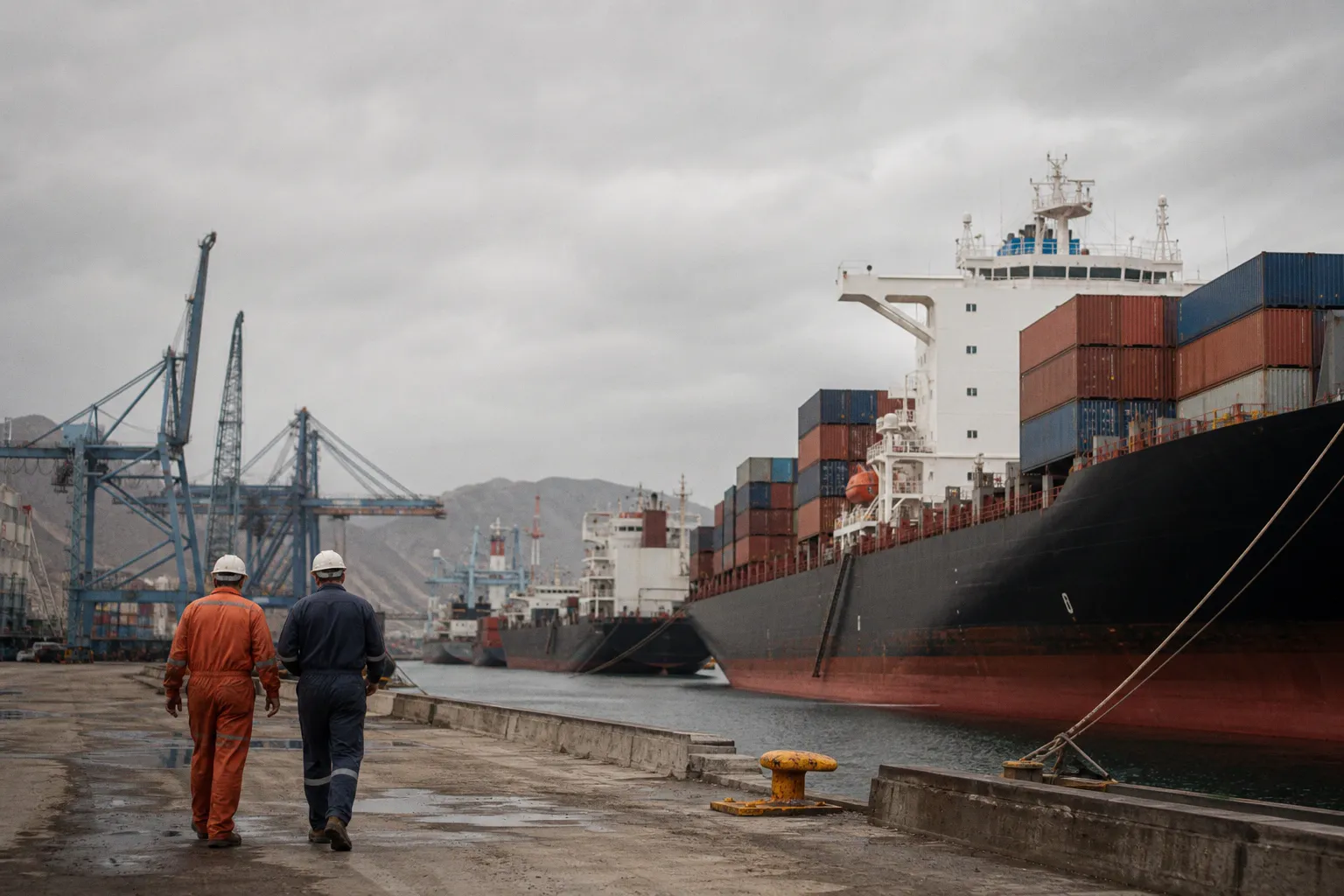
The IMF's model assumes the Strait of Hormuz begins reopening in mid-July and returns to a pre-war state by March 2027. That assumption is doing an enormous amount of analytical work. Before the conflict, roughly a fifth of global oil and liquefied natural gas trade moved through the strait. Verified transits on Tuesday stood at 41 — compared with approximately 130 daily crossings before the war. That is not a minor disruption; it is a structural chokepoint operating at roughly a third of baseline capacity.
Compounding the fragility: the forecast was assembled before Washington renewed strikes on Iran following attacks on three commercial vessels in the strait, and before a second round of bombing on Wednesday. President Trump declared the ceasefire "over" hours before the Pentagon confirmed further action. Brent crude responded accordingly — surging as much as 7 percent, briefly topping $79 a barrel, and settling near $78.76, up roughly $8 from the same point last week. Market analysts noted that prices had already retreated to near pre-war levels, suggesting traders had priced in a best-case diplomatic outcome resting on, in one analyst's words, "little more than a high-level MOU." The re-escalation shattered that consensus in days.
Two Opposing Forces: Energy Drag vs. AI Acceleration
The most structurally interesting element of the IMF's latest outlook is the framing itself. Petya Koeva Brooks, deputy director of the fund's research department, described "two powerful forces pulling in opposite directions" — the energy shock on one side, a technology-driven investment boom on the other. This is not a standard cyclical slowdown narrative. It is a description of an economy whose growth engines are being pulled apart by exogenous shocks on the supply side and endogenous acceleration on the technology side.
The regional divergence makes this tension visible. The US is forecast to lead major advanced economies at 2.3 percent growth — buoyed in part by capital formation around AI infrastructure. The Eurozone trails at 0.9 percent, Japan at 0.6 percent, the UK at 1 percent, Canada at 1.1 percent. China, classified as emerging, is projected at 4.6 percent. The gap between the US and its peers is not primarily a demand story; it is a capital allocation story, with compute and semiconductor investment concentrating in American markets.
Global inflation, meanwhile, is projected to climb to 4.7 percent this year — up from 4.1 percent in 2025 — before easing to 3.9 percent in 2027. That trajectory suggests central banks face a sustained cost-push environment rather than a transitory blip, particularly if oil supply remains constrained beyond the IMF's mid-July reopening assumption.
What the Forecast Is Actually Pricing
The 3 percent headline number matters less than the assumptions it rests on. The IMF is modeling a specific sequence: ceasefire holds, strait reopens gradually, oil normalizes by early 2027, and AI investment continues absorbing capital at current rates. Each of those variables has a cascading dependency. If the strait does not reopen by mid-July — or if renewed US strikes provoke further Iranian retaliation against shipping — the energy price floor rises, inflation persists longer, and the AI-offset narrative weakens as input costs climb.
The practical signal for anyone reading macro data: this is not a forecast to take at face value. It is a conditional projection built on a geopolitical ceasefire that has visibly collapsed within 48 hours of the outlook's release. The structural friction between energy supply constraints and technology-driven demand is real, but the balance between those forces is far more fragile than the 3 percent figure implies.