Xavier Pennington, Lead Columnist, Systems & Macro-Trends
July 09, 2026 · 14 min read
Quantum computing explained: the shift to logical qubits
The most important number in quantum computing is no longer the headline qubit count. It is the error rate after correction. That shift sounds technical. It is structural.
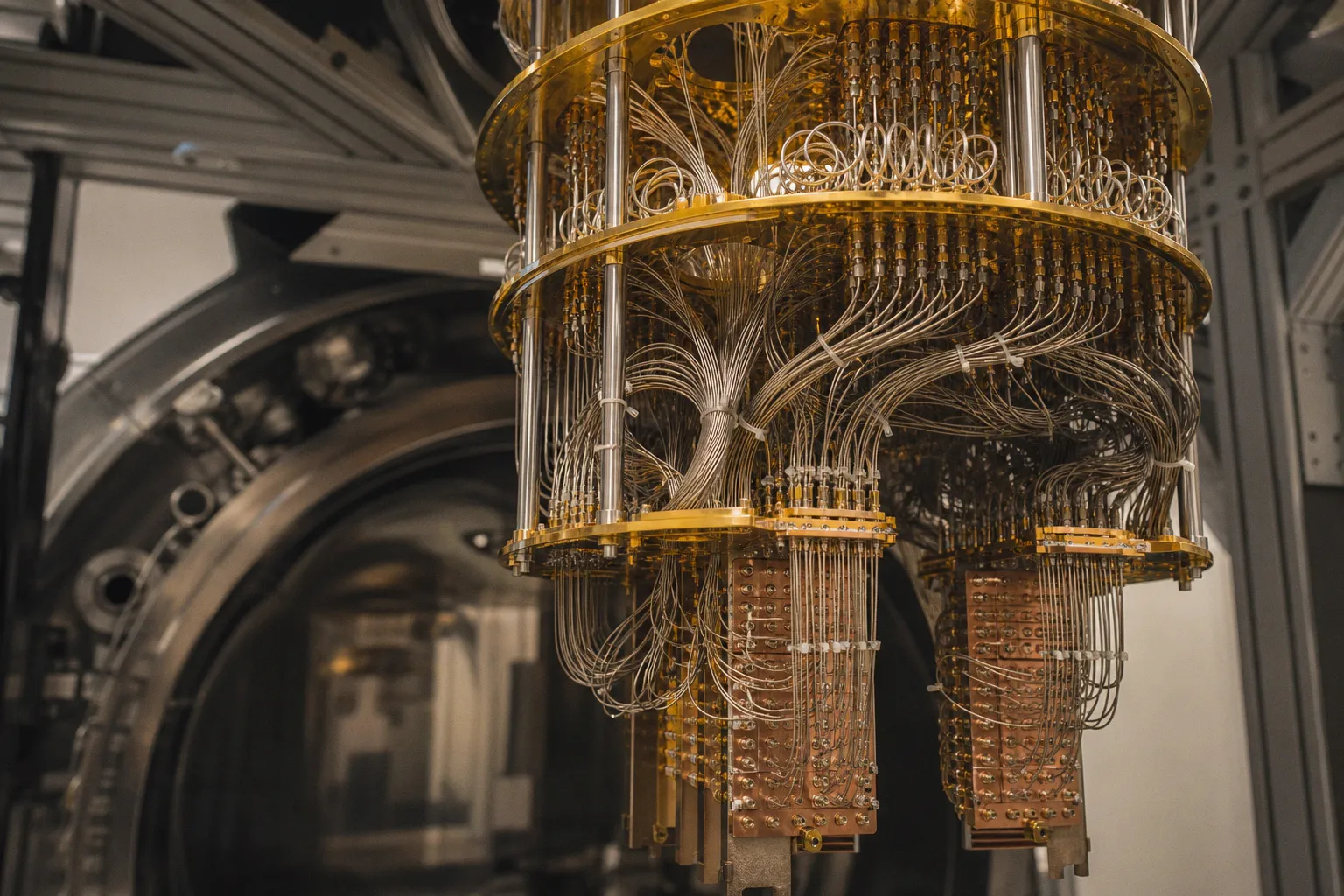
This is where quantum computing explained properly has to leave the showroom. A physical qubit is not a tiny magical transistor. It is a fragile quantum system sitting inside a hostile universe. Heat, vibration, stray electromagnetic fields, imperfect gates, measurement errors — all of these create decoherence and operational noise. The machine does not simply need more qubits. It needs qubits whose errors can be detected, isolated, and corrected faster than they accumulate.
The pivot to logical qubits is the industry’s admission that scale without correction is a dead end.
The physical qubit problem: useful physics, hostile engineering
Quantum computing basics usually begin with superposition and entanglement. That is necessary, but incomplete. A qubit can represent quantum information in states that are not limited to classical 0 or 1. Multiple qubits can be entangled so that the state of one cannot be described independently from the others. This is why certain quantum algorithms, at least in principle, can attack problems that are structurally hard for classical machines.
But “in principle” is doing heavy lifting.
A physical qubit is a real object: a superconducting circuit, a trapped ion, a photon, a spin system, or another engineered quantum platform. Each modality has its own strengths and failure modes. Superconducting qubits can be fast and manufacturable but demand extreme cryogenic control. Trapped ions can show high fidelity and long coherence times but face different scaling and control constraints. Photonic systems shift the engineering burden elsewhere. There is no universal conversion table that turns one physical qubit into another.
The common constraint is noise.
Noise produces two linked problems. First, the quantum state decays or drifts before the computation completes. Second, operations on qubits — gates, measurements, resets — introduce errors. Classical computers also have errors, but they are buried under robust digital abstraction. A transistor does not need to preserve a delicate phase relationship across an entangled state. A quantum processor does.
That is why the Noisy Intermediate-Scale Quantum era, usually abbreviated as NISQ, has been both productive and misleading. It gave the field machines large enough to test control systems, calibration, algorithms, and benchmarking methods. It did not give the field a direct path to general useful computation. NISQ devices can demonstrate quantum behavior. They can explore narrow experimental workloads. They cannot simply be enlarged until they become reliable universal quantum computers.
The barrier is not only size. It is error propagation.
A quantum circuit with many operations behaves like a financial system with hidden leverage. Small local failures cascade. A slightly imperfect two-qubit gate becomes a corrupted entangled state. A measurement error contaminates the next correction cycle. A longer algorithm amplifies the defect rate. At sufficient depth, the output becomes statistically useless.
The central engineering problem is not making qubits exist. It is making quantum information survive contact with the machine built to process it.
Logical qubits: the abstraction quantum computing has been missing
A logical qubit is not a better single qubit. It is an encoded qubit. Quantum information is distributed across multiple physical qubits in such a way that certain errors can be detected and corrected without directly copying the quantum state. That last condition matters. The no-cloning theorem prevents the simple classical tactic of “make three copies and vote.” Quantum error correction has to infer error syndromes indirectly, preserving the encoded information while extracting enough data to repair it.
This is the conceptual hinge in logical qubits vs physical qubits:
| Parameter | Physical qubit | Logical qubit |
|---|---|---|
| What it is | A real quantum device or system | An error-corrected abstraction encoded across many physical qubits |
| Main weakness | Decoherence, gate errors, measurement noise | Overhead, complexity, correction-cycle demands |
| Scaling metric | Number of devices fabricated and controlled | Stability of encoded information over useful computation |
| Failure mode | Individual errors directly corrupt computation | Errors exceed the code’s correction capacity |
| Strategic value | Enables experiments and near-term prototypes | Enables the path toward fault-tolerant computing |
The point is not to eliminate errors. That is unrealistic. The point is to push error rates below a threshold where correction improves the system faster than noise damages it. Once below that threshold, adding more physical qubits to an error-correcting code can reduce the logical error rate. Above it, added complexity merely creates a larger failure surface.
This is the first hard lesson: more hardware is not automatically progress. More hardware with insufficient fidelity can deepen the problem.
The second lesson is overhead. A useful logical qubit may require hundreds or thousands of physical qubits, depending on physical error rates, the error-correction code, architecture, connectivity, and algorithm. A commonly cited order-of-magnitude estimate is around 1,000 physical qubits for one fault-tolerant logical qubit, but that ratio is not a law. It is a systems variable. Better physical qubits reduce overhead. Better codes reduce overhead. Better decoding software reduces overhead. Better connectivity and control can reduce overhead. Weakness in any layer increases it.
The structure is unforgiving. Fault tolerance is not a component; it is a stack.
Surface codes and the logic of correction
The surface code has become one of the dominant models for discussing quantum error correction because it maps comparatively well onto two-dimensional layouts and local interactions. It does not require every qubit to talk to every other qubit. That architectural restraint matters, especially for superconducting systems.
The key concept is code distance, usually written as d. Code distance describes how many physical errors a code can tolerate before a logical error becomes possible. In simplified terms, a distance-3 surface code can correct one physical qubit error. A distance-5 surface code can correct two. Larger code distance means stronger protection, but also more physical qubits and more correction operations.
This creates a precise test of whether the field is moving in the right direction. If scaling the code from distance-3 to distance-5 reduces the logical error rate, then the correction system is suppressing errors as intended. If the larger code performs worse, the machine is not yet below the practical threshold where error correction compounds favorably.
In 2023, Google Quantum AI reported exactly the kind of milestone the field needed: increasing a surface code from distance-3 to distance-5 reduced the error rate per logical qubit. That result did not mean a commercially useful quantum computer had arrived. It meant something narrower and more important. The correction machinery behaved in the direction fault tolerance requires.
There is a tendency in public discussion to treat such milestones as either hype or anticlimax. Both readings miss the mechanism. Quantum computing does not cross from impractical to transformative in one announcement. It crosses through a sequence of threshold events:
1. Physical qubit fidelity improves enough that correction is not self-defeating. If every operation introduces too much noise, error correction only adds more places for failure.
2. Larger codes outperform smaller codes. This is the sign that overhead is buying stability, not merely complexity.
3. Logical qubits remain stable across increasingly long circuits. Short demonstrations are necessary. They are not sufficient for deep computation.
4. Logical operations become reliable, not just logical memory. Storing a corrected state is one level. Computing with corrected states is a higher level.
5. Many logical qubits interact under fault-tolerant rules. A single reliable logical qubit is a milestone. Useful algorithms require networks of them.
This is the cause-and-effect chain often missing from popular explanations of how quantum computers work. The machine is not useful because it is quantum. It becomes useful when the quantum substrate is disciplined into a reliable computational abstraction.
Why the 2024 Microsoft–Quantinuum result mattered
The 2024 announcement from Microsoft and Quantinuum belonged to the same structural category. The companies reported highly reliable logical qubits produced by combining Microsoft’s error-diagnostics software with Quantinuum’s trapped-ion hardware. The headline figure was striking: an error rate 800 times better than the underlying physical qubits.
That number should be read carefully. It does not mean fault-tolerant quantum computing is commercially available. It does not mean every hardware architecture can reproduce the result under identical assumptions. It does not mean the overhead problem has been solved.
It does mean the software-hardware boundary is becoming one of the decisive fronts.
Quantum error correction is not simply a hardware problem. It depends on measurement schedules, syndrome extraction, decoding algorithms, calibration routines, and control logic. The physical machine produces a stream of imperfect information about possible errors. The decoding layer must interpret that stream fast and accurately enough to decide which correction is needed. In that sense, the logical qubit is an institutional product of the full stack: device physics, control electronics, software, code design, and system architecture.
The Microsoft–Quantinuum result is significant because it frames error suppression as an integrated systems achievement. Trapped-ion hardware provides one error profile and connectivity model. Error-diagnostics software exploits that profile. The improvement comes from matching layers, not from treating the qubit as an isolated commodity.
This is where the market’s old vocabulary starts to fail. Asking which company has “the most qubits” is like evaluating aviation by counting aluminum panels. The relevant question is whether the assembled system produces a stable flight envelope.
The physical-to-logical ratio is the economic bottleneck
The physical-to-logical ratio is not an academic detail. It is the economic bottleneck of the sector.
If one logical qubit requires roughly 1,000 physical qubits, then a machine with one million physical qubits yields around 1,000 logical qubits before accounting for architecture-specific details, routing, magic-state distillation, control overhead, and algorithmic requirements. The actual ratio can be better or worse. But the order of magnitude changes how every forecast should be interpreted.
This ratio also explains why quantum computing applications remain unevenly distributed between near-term experimentation and long-term potential. The most discussed applications — cryptanalysis, quantum chemistry, materials simulation, optimization, and certain sampling problems — do not all require the same scale, depth, or error tolerance. Breaking widely used public-key cryptography would require a very different level of fault-tolerant capacity than a small chemistry simulation. A narrow scientific workload may become valuable earlier than a general industrial platform.
The constraint is algorithmic depth. Some calculations need many sequential operations. Even modest per-operation error rates become destructive over deep circuits. That is why logical error rates matter more than raw physical qubit counts. A shallow demonstration can survive noise. A deep algorithm cannot.
The industry therefore has three compounding tasks:
- Reduce physical error rates. Better fabrication, isolation, control, and calibration lower the burden placed on error correction.
- Improve error-correction codes and decoders. Better codes can extract more stability from the same hardware, while faster decoders prevent correction latency from becoming another failure channel.
- Scale control infrastructure without adding prohibitive noise or cost. Wiring, cryogenics, lasers, electronics, and measurement systems become system-level constraints as machines grow.
- Demonstrate logical operations, not just logical storage. A stable encoded qubit is necessary. Fault-tolerant gates between logical qubits are the next structural requirement.
- Connect hardware roadmaps to algorithmic needs. A machine useful for one class of problems may still be irrelevant to another. “Useful quantum computer” is not a single threshold.
The logical qubit turns quantum computing from a physics contest into a systems-engineering contest. That is progress, and it is also a harsher standard.
Why this transition changes the investment narrative
The shift from physical to logical qubits changes how the sector should be evaluated. It does not make the field less ambitious. It makes the milestones less forgiving.
Under the old narrative, a company could point to qubit count, cloud access, or a benchmark demonstration. These were not meaningless. They showed operational competence. But they did not prove a path to fault tolerance. Under the new narrative, the decisive signals are more specific:
| Signal | Why it matters | Weak version | Stronger version |
|---|---|---|---|
| Logical error suppression | Shows correction is working | One-off improvement in a narrow test | Larger codes consistently reduce logical error |
| Code distance scaling | Tests whether overhead buys reliability | Distance-3 demonstration only | Distance-5 and beyond improve outcomes |
| Physical-to-logical overhead | Determines economic feasibility | Thousands of devices for fragile logical behavior | Falling overhead through better hardware and codes |
| Logical gate fidelity | Moves from memory to computation | Corrected idle qubit | Reliable operations between logical qubits |
| Runtime stability | Determines useful circuit depth | Short experimental interval | Long computations with sustained correction |
This framework cuts through two forms of noise.
The first is promotional compression. Every breakthrough is described as a step toward practical quantum computing. Technically, that may be true. Structurally, the step may be small, broad, or narrow. A useful evaluation asks where the result sits in the chain: physical fidelity, error correction, logical memory, logical gates, multi-logical-qubit systems, or algorithm execution.
The second is skeptical flattening. Critics often observe that quantum computers have not yet transformed industry, then imply the whole field is speculative vapor. That is too crude. The field has produced measurable progress in control, fabrication, error correction, and logical encoding. The absence of commercial fault tolerance is not the absence of technical advance. It is evidence that the engineering ladder is long.
A mature view holds both positions: progress is real; timelines remain structurally constrained.
Fault tolerance is not one breakthrough away
Fault-tolerant quantum computing requires the system to keep errors under control throughout a computation. That means errors must not spread uncontrollably through gates. Correction cycles must run repeatedly. Logical qubits must interact without collapsing the reliability gained from encoding. The entire machine must operate as a disciplined architecture, not as a laboratory collection of fragile quantum effects.
This is why long-term stability remains a research problem. Current demonstrations are essential, but they occur over limited durations and under controlled experimental conditions. The question is not whether a logical qubit can be made more reliable than its physical components. That has now been demonstrated in important ways. The question is whether many logical qubits can sustain deep, fault-tolerant circuits at a cost, size, and reliability level that supports valuable applications.
The answer is not yet established.
That uncertainty should not be confused with ignorance. The pathway is clearer than it was during the early NISQ years. The field now has a better map of the bottlenecks. It knows that raw qubit count is insufficient. It knows that code distance scaling matters. It knows that software decoding and hardware error profiles must be co-designed. It knows that physical-to-logical overhead determines economic viability.
The unresolved part is execution at scale.
The useful way to read the next quantum milestone
The next wave of announcements will likely contain larger logical-qubit demonstrations, improved code distances, better decoder performance, and more claims about fault-tolerant roadmaps. The correct response is neither reflexive excitement nor reflexive dismissal. The correct response is structural interrogation.
Does the result show logical error rates falling as the code scales? Does it include operations or only storage? How many physical qubits are consumed per logical qubit? What hardware modality is being used, and how does that affect overhead? Does the demonstration extend runtime, circuit depth, or multi-logical-qubit interaction? Is the improvement reproducible across more than a narrow benchmark?
These questions matter because quantum computing is entering its abstraction phase. Classical computing became powerful not because humans learned to love transistors, but because layers of abstraction turned unreliable physical phenomena into reliable computation. Quantum computing needs the same transformation under far harsher physics.
Logical qubits are the beginning of that transformation. They are not the final machine. They are the first serious attempt to build a stable computational layer above quantum fragility.
So quantum computing explained in 2024 and beyond should start with a correction to the old premise. The future does not belong to the processor with the largest number of physical qubits on a slide. It belongs to the architecture that can convert unstable quantum components into reliable logical operations, repeatedly, at scale, and with tolerable overhead.
That is the real transition now underway. It is slower than the marketing cycle. It is more rigorous than the hype. And it is the only path by which quantum computing becomes more than an extraordinary experiment.