Xavier Pennington, Lead Columnist, Systems & Macro-Trends
July 06, 2026 · 17 min read
Why I check climate change effects on municipal bond yields
A 30-year municipal bond is a wager on a place. Not in the abstract civic sense. In the mechanical sense: roads, storm drains, assessed property values, insurance availability, population stability…
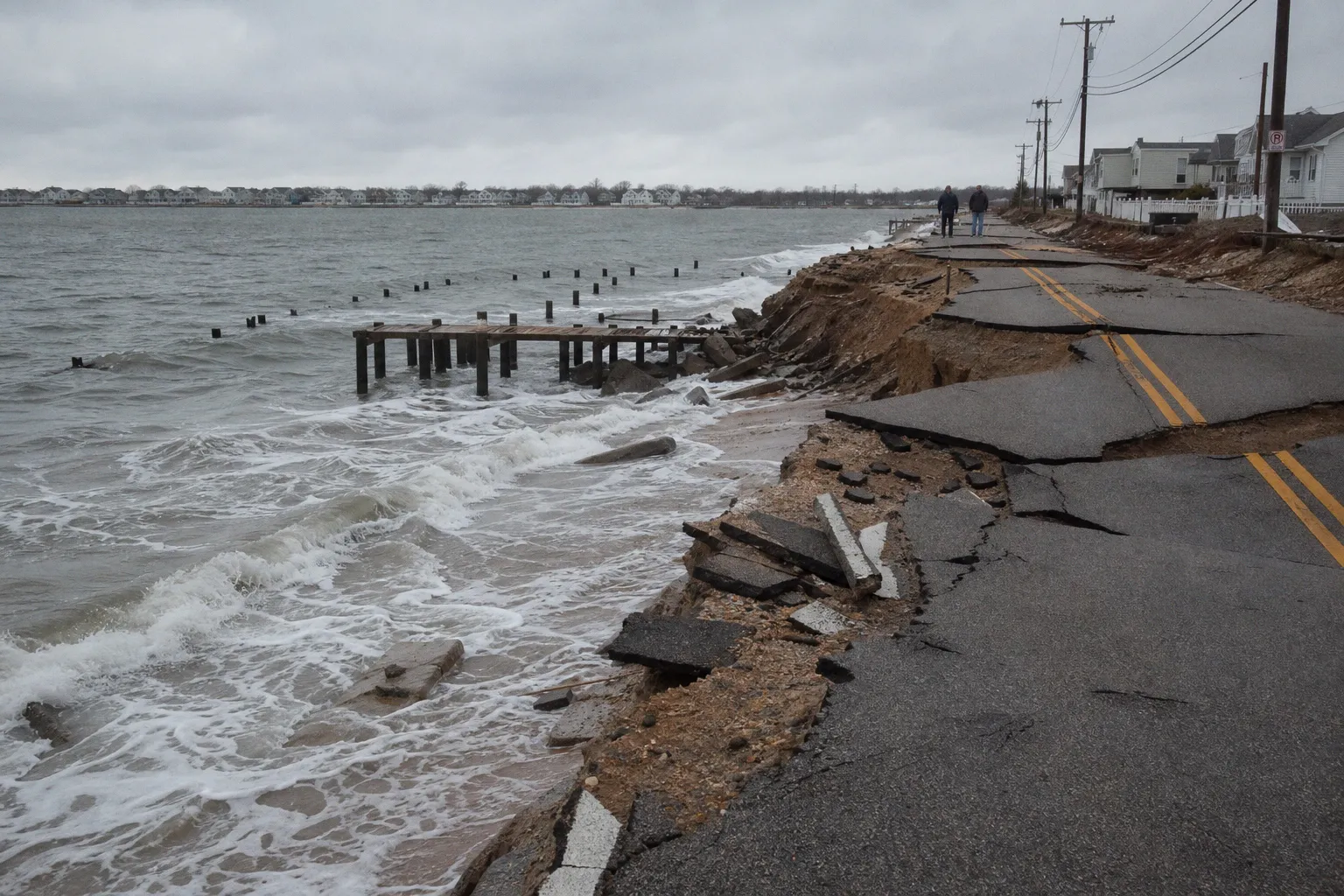
A 30-year municipal bond is a wager on a place. Not in the abstract civic sense. In the mechanical sense: roads, storm drains, assessed property values, insurance availability, population stability, taxable commerce, and the political capacity to raise revenue after the next shock.
That is why I check climate change effects before I look too closely at yield. The coupon is visible. The feedback loops are not. A coastal county can look solvent on the current balance sheet and still be underwriting a slow collision between rising infrastructure costs and a shrinking property-tax base. An inland city can appear insulated from sea-level rise while carrying transition risk through a tax base tied to fossil fuel logistics, heavy industry, or water-intensive agriculture. Municipal credit is local. Climate risk is local first, systemic second.
The municipal bond market has a climate-duration problem
The key mismatch is simple. Municipal bonds often mature over 10 to 30 years. Climate risk also compounds over 10 to 30 years. Yet the documents used to sell and price those bonds are still uneven, fragmented, and often better at describing the last fiscal year than the next three decades.
That mismatch does not mean every climate-exposed bond is mispriced. It does not mean climate risk is the dominant driver of municipal yields. Interest rates, inflation, state aid formulas, pension burdens, liquidity, call structure, and the issuer’s economic base still matter enormously. But climate risk changes the distribution of outcomes. It thickens the tail.
The market has started to recognize this. Rating agencies, including Moody’s and S&P Global, have integrated environmental and climate risk into municipal credit methodologies. The SEC has increased attention on climate-related disclosure in the municipal market. Academic and central-bank research has also pushed the question from environmental ethics into credit mechanics: does exposure to floods, fires, heat, drought, hurricanes, and transition policy affect the spread demanded by investors?
The answer is not uniform. It is conditional. It depends on geography, fiscal flexibility, infrastructure condition, insurance markets, state support, population mobility, and debt maturity. That conditionality is exactly why the subject deserves more attention, not less.
Climate risk in municipal debt is not a moral overlay. It is a term-structure problem with drainage pipes, tax rolls, and political constraints attached.
A one-year note can ignore many risks that a 2049 maturity cannot. The longer the duration, the more the bond becomes exposed to slow-moving variables: sea-level rise, chronic heat, wildfire zones, water scarcity, decarbonization policy, and the retreat of private insurance. Climate change effects are therefore not a separate “green” screen. They are part of credit surveillance.
Physical risk turns infrastructure into a fiscal transmission channel
The first mechanism is physical damage. Extreme weather events can break assets that local governments must maintain: roads, culverts, bridges, treatment plants, schools, electrical substations, seawalls, ports, and public housing. The effect is not only the repair bill. It is the sequence that follows.
A flood damages infrastructure. Emergency spending rises. Federal reimbursement may arrive late or incompletely. The municipality reallocates funds from maintenance or capital plans. Deferred maintenance increases future vulnerability. Property values in exposed areas weaken or become more volatile. Insurance costs rise. Some households relocate. The tax base narrows. Borrowing costs may rise just when the issuer needs new capital.
That is a feedback loop. Municipal credit analysis is often about feedback loops.
Physical climate risk has several channels:
- Direct capital costs. Rebuilding roads, stormwater systems, wastewater plants, and public facilities after extreme weather can push local budgets into repeated emergency mode. A single event can be absorbed. Repeated events change the fiscal baseline.
- Revenue impairment. Property tax is the structural revenue engine for many local governments. If flood risk, wildfire risk, or chronic heat reduces property values, the tax base absorbs the climate signal.
- Population and business migration. Local credit quality depends on people and firms choosing to remain. Climate shocks can accelerate out-migration, especially where insurance and utility costs rise faster than income.
- Insurance market stress. When private insurance becomes more expensive or less available, property markets weaken. Municipalities then face both social pressure and fiscal drag.
- Maintenance crowd-out. Spending on disaster response can displace routine maintenance. That creates a compounding deterioration cycle: weaker assets, higher future losses, more debt issuance.
The market does not always price these channels cleanly. A municipality may have high exposure but strong reserves, a wealthy tax base, and access to state or federal support. Another may have moderate exposure but weak governance and limited fiscal flexibility. The climate variable cannot be read in isolation.
Still, physical risk is easier to conceptualize than to price. Investors understand hurricanes and wildfires. They understand that a 1-in-100-year flood event is no longer a static category if the underlying climate distribution is shifting. What is harder is estimating when that risk becomes a spread.
The spread may appear only after a visible shock. It may appear first in longer-dated maturities. It may be hidden by broader rate moves. It may be overwhelmed by demand for tax-exempt income. But absence of a clean market signal is not absence of risk. It is often just structural friction.
Transition risk is the quieter municipal problem
Physical damage attracts attention because it leaves images. Transition risk is less photogenic and often more subtle. It concerns what happens when regulation, technology, markets, and capital allocation move away from carbon-intensive activity.
For municipalities, the transition channel usually runs through the tax base.
A county dependent on coal extraction, oil and gas production, refining, petrochemical processing, fossil-fuel transport, or combustion-related manufacturing is not merely exposed to climate policy in a distant federal sense. It may depend on property taxes, sales taxes, severance-related flows, employment, port fees, utility revenues, or industrial assessments tied to assets that can become less valuable under decarbonization.
The phrase “stranded assets” is often used for corporate balance sheets: coal plants, pipelines, reserves, refineries. But local governments can inherit the fiscal version of the same problem. A plant closes. A rail terminal loses volume. A refinery becomes less competitive. A major industrial taxpayer appeals its assessment. Workers leave. Retail sales weaken. School districts and local authorities still carry fixed costs.
This is the transition-risk chain:
| Climate-related pressure | Municipal transmission channel | Credit consequence |
|---|---|---|
| Carbon regulation tightens | Fossil fuel and heavy industrial assets lose value | Lower assessed valuation and weaker tax base |
| Energy technology shifts | Employment moves away from legacy sectors | Population and income pressure |
| Capital markets reprice carbon exposure | Private investment declines in exposed regions | Slower growth and weaker development pipeline |
| Utilities retire old assets | Local revenue tied to plants or infrastructure falls | Budget gaps and possible service cuts |
| Litigation or cleanup obligations rise | Local or quasi-public entities face added costs | Higher debt burden or reduced flexibility |
The crucial point is not that every fossil-fuel-linked municipality will fail. Many will adapt. Some will attract new industries. Some will receive state support. Some will repurpose infrastructure successfully. But transition risk changes the underwriting question from “what does the current tax base look like?” to “which parts of the tax base are durable under a decarbonizing economy?”
That question became more prominent after the Paris Agreement in 2015, when the transition pathway became a central assumption in policy, finance, and corporate planning. The pace remains contested. The direction is less contestable. Electricity generation, transportation, industrial heat, buildings, and agriculture are all under pressure to reduce emissions. Municipalities sit underneath those sectors. Their budgets absorb the second-order effects.
This is also where investors often make a category error. They treat “climate risk” as if it means only coastal flooding or wildfire maps. That is too narrow. A landlocked jurisdiction with heavy dependence on fossil fuel extraction can carry more climate-related credit risk than a coastal city with strong wealth, adaptation plans, and broad revenue authority.
The climate risk premium is real, but not a universal label
The phrase “climate risk premium” can become lazy if used as a blanket claim. Municipal markets are too fragmented for that. There are tens of thousands of issuers, multiple revenue structures, varying legal protections, different state regimes, and uneven disclosure. A school district bond, a general obligation bond, a water revenue bond, a port bond, and a special tax bond do not transmit climate risk through the same mechanism.
A useful way to think about the premium is not as a fixed add-on, but as a conditional spread response. Investors demand more yield when climate exposure intersects with weak resilience, long maturity, poor disclosure, limited fiscal flexibility, or concentrated revenue.
Long-dated bonds are where this matters most. A five-year maturity can often survive uncertainty by relying on current reserves and near-term revenues. A 30-year maturity cannot. Over that horizon, sea-level rise, repeated extreme weather, heat stress, fire risk, water scarcity, and transition policy can reshape the local economy.
The yield spread between climate-exposed and climate-resilient municipal bonds is therefore most likely to become visible when several conditions align:
1. The exposure is geographically specific and credible. Floodplain maps, wildfire hazard data, drought stress, heat projections, and storm-surge exposure are more persuasive than generic climate language.
2. The asset base is difficult to relocate. Roads, ports, wastewater plants, schools, and public utilities cannot move quickly. Fixed infrastructure makes climate exposure more credit-relevant.
3. The revenue base is narrow. A diverse metropolitan economy can absorb shocks better than a jurisdiction dependent on one industry, one taxpayer, or one vulnerable corridor.
4. The maturity is long. The longer the bond, the more climate variables enter the expected-loss calculation.
5. The issuer has weak adaptive capacity. Reserves, capital planning, state support, grant access, engineering capacity, and governance quality all mediate risk.
6. Disclosure is thin. Markets penalize opacity when uncertainty rises. If an issuer cannot describe its exposure and adaptation plan, investors may assume the gap is material.
This is not a clean laboratory. Municipal bonds are not equities with continuous price discovery and uniform reporting. Liquidity is uneven. Many bonds trade infrequently. Tax treatment affects demand. Retail ownership can blur signals. That is why any claim that “the market prices climate risk” must be handled carefully. Sometimes it does. Sometimes it does late. Sometimes it does only after disaster.
There is a useful analogy in early-stage project finance, where investors distinguish between a compelling narrative and a bankable risk structure. The same discipline appears in climate-exposed municipal debt: capital providers need to know not only what is promised, but who bears loss if assumptions fail. That logic is familiar to anyone studying crowdfunding and crowd-investing risk, where dispersed capital can underestimate structural downside if disclosure is weak.
Municipal markets have a more established legal architecture than crowdfunding, of course. But the underwriting instinct is similar: narrative yield is not the same as risk-adjusted yield.
Rating agencies have moved climate from footnote to methodology
The integration of climate risk into credit ratings is one of the most important structural shifts in municipal finance. Moody’s signaled the relevance of environmental risks to U.S. state and local government credit years ago, and S&P Global has also incorporated ESG considerations into municipal analysis. This does not mean every exposed issuer receives an immediate downgrade. Ratings move through evidence, methodology, and materiality. But climate is no longer outside the credit frame.
The rating question is direct: can the issuer absorb the risk without impairing debt service?
That breaks down into several sub-questions:
- Does the issuer have infrastructure exposed to extreme weather, sea-level rise, wildfire, drought, or heat?
- Are capital plans aligned with the scale of the exposure?
- Is the tax base vulnerable to property-value decline or industry transition?
- Does the issuer have legal flexibility to raise revenue?
- Are reserves adequate for repeated shocks, not just isolated events?
- Is there access to state and federal support?
- Does management understand the exposure and disclose it coherently?
The last point is underrated. Climate risk is partly physical and partly institutional. Two municipalities can face similar flood exposure and produce different credit outcomes. One has updated drainage plans, floodplain controls, capital sequencing, insurance analysis, and transparent disclosure. The other has outdated maps, deferred maintenance, and generic language in offering documents. The hazard may be similar. The credit risk is not.
The market is not only pricing water, fire, heat, and carbon. It is pricing managerial competence under stress.
A potential multi-notch downgrade for a high-risk municipality is not a theoretical curiosity. It is the logical endpoint of cascading exposure: repeated damage, declining tax base, rising debt, shrinking flexibility, and weak governance response. Most issuers will not travel the full path. But bond analysis is about identifying which ones could.
Disclosure fragmentation keeps the market inefficient
The municipal market has a disclosure problem. Climate data exists. Issuer-level integration remains fragmented.
Some large issuers now provide credible climate resilience plans, greenhouse gas inventories, capital adaptation strategies, and detailed risk assessments. Many smaller issuers do not. Some lack the technical staff. Some lack resources. Some see no immediate market reward for better reporting. Some fear that candid disclosure may raise borrowing costs. The result is an uneven information field.
This fragmentation creates three problems.
First, investors cannot easily compare issuers. One coastal city may disclose flood-zone exposure, capital improvements, sea-wall investments, and stormwater upgrades. Another may offer vague language about “natural disasters” without asset-level detail. The second document is not safer. It is less legible.
Second, pricing becomes reactive. If climate risk is not disclosed or modeled consistently, markets may wait for events: a wildfire, a flood, a plant closure, a water crisis, an insurance shock. That produces abrupt repricing rather than gradual risk adjustment.
Third, weak disclosure can subsidize weak adaptation. If municipalities face little spread penalty for poor climate planning, the incentive to invest early is reduced. This is a classic externality inside a credit market. The cost of underinvestment is deferred until the shock arrives, then distributed across taxpayers, bondholders, insurers, state budgets, and federal disaster programs.
The SEC’s increased focus on climate-related disclosure for municipal issuers since 2021 reflects this structural gap. But municipal disclosure is not the same as corporate disclosure. The issuer universe is more fragmented. The legal regime is different. The capacity gap between a major state authority and a small local district is immense.
Standardization would help, but it will not eliminate judgment. Climate exposure cannot be reduced to a single score without losing important context. A useful disclosure regime would separate hazard, exposure, vulnerability, adaptation, and fiscal capacity.
That distinction matters:
| Category | What it asks | Why it matters for yield |
|---|---|---|
| Hazard | What climate events are more likely or severe? | Establishes the external threat |
| Exposure | Which assets and revenues sit in harm’s way? | Links climate to the balance sheet |
| Vulnerability | How fragile are those assets and revenues? | Measures loss potential |
| Adaptation | What is being done to reduce risk? | Shows management response |
| Fiscal capacity | Can the issuer pay for resilience and recovery? | Determines credit absorption |
A bond document that says “the issuer may be affected by severe weather” tells the market almost nothing. A document that identifies vulnerable facilities, capital costs, funding sources, flood standards, insurance assumptions, and revenue sensitivity gives investors a usable credit map.
Not all municipal climate risk is equal
The temptation is to rank climate risk by headline hazard. Coastal equals risky. Inland equals safe. Fossil-fuel region equals doomed. Wealthy city equals resilient. These shortcuts fail quickly.
A wealthy coastal municipality with high property values may have substantial exposure, but also strong revenue capacity, engineering resources, political access, and bonding flexibility. A poorer inland city may face extreme heat, water stress, old infrastructure, and limited reserves. A fossil-fuel-dependent county may be vulnerable to transition, but if it has low debt, conservative budgeting, and active diversification, the risk may be manageable. A fast-growing sunbelt city may look strong while building infrastructure into water scarcity.
The relevant question is not “is there climate risk?” There is. The relevant question is “how does the risk enter debt service?”
For general obligation bonds, the channel is usually tax base and fiscal flexibility. For revenue bonds, the channel may be demand, operating cost, capital expenditure, or asset impairment. A water utility in a drought-prone region faces a different structure than a school district exposed to wildfire property loss. A port authority exposed to sea-level rise and trade shifts has a different profile than a transit agency facing heat-related maintenance and ridership volatility.
This is the practical classification I use:
1. Asset-heavy physical exposure. Water systems, wastewater plants, ports, roads, bridges, and utilities in high-hazard zones.
2. Tax-base exposure. Jurisdictions where property values or major taxpayers are vulnerable to climate damage or transition.
3. Operating-cost exposure. Issuers facing higher cooling loads, fire prevention costs, water procurement costs, insurance costs, or maintenance costs.
4. Demand exposure. Systems whose revenue depends on population, tourism, trade volume, water usage, or industrial activity that climate can disrupt.
5. Governance exposure. Issuers that lack planning capacity, disclosure discipline, or political willingness to adapt rates, taxes, zoning, and capital budgets.
The fifth category is often decisive. Climate hazard can be measured. Governance quality must be inferred. That makes it messier, but not optional.
Yield can compensate for risk only if the risk is understood
There is nothing inherently irrational about owning climate-exposed municipal debt. The market exists to price risk, not avoid it categorically. A higher yield may compensate for exposure if the investor understands the mechanism, the maturity, the legal pledge, the issuer’s resilience, and the probability of spread widening.
The problem is false precision. Climate models, bond cash flows, demographic projections, and fiscal assumptions all carry uncertainty. Combining them does not produce certainty. It produces a structured range of outcomes. That range is still useful. It prevents the worst analytical error: treating a long-dated local credit as if the next 30 years will resemble the last 30.
I do not look for a single climate score. I look for pressure points.
- Is the issuer’s capital plan consistent with known hazard exposure?
- Are revenue assumptions sensitive to property values, population, tourism, or a carbon-intensive employer?
- Does the bond mature inside the window where climate effects become materially more severe?
- Has the issuer disclosed adaptation costs, or only acknowledged disaster risk in generic language?
- Are reserves and debt capacity sufficient after repeated events, not merely after one shock?
- Does the legal pledge isolate bondholders from the exposed revenue stream, or tie them directly to it?
- Is the spread wide enough to compensate for uncertainty, liquidity, and possible downgrade risk?
That last question cannot be answered universally. The confirmed research is clear on direction, not on a single numerical adjustment. Exact yield impact varies widely by issuer, geography, maturity, bond structure, and market conditions. Anyone offering a simple climate basis-point formula is overselling the evidence.
But uncertainty is not a reason to ignore the variable. It is the reason to demand margin.
The market will get more explicit because the losses will
The municipal bond market has always been a map of American federalism: thousands of local issuers, uneven resources, layered legal pledges, tax preferences, and a persistent belief that essential public finance is safer than corporate risk. Much of that belief is justified. Municipal defaults remain uncommon relative to many other credit markets.
Climate change does not overturn that structure. It stresses it.
Physical risk raises the cost of maintaining the public asset base. Transition risk challenges the durability of local tax bases. Disclosure fragmentation slows market learning. Rating agencies have moved climate into methodology, but ratings are not real-time instruments. Investors are beginning to price exposure, especially in longer-dated debt, yet the signal remains uneven.
That is the market anomaly: long-term municipal bonds are claims on places whose climate-adjusted cost structures are changing faster than their disclosure architecture.
This is why I check climate change effects on municipal bond yields. Not to impose an environmental preference on a credit decision. Not to assume every exposed municipality is a bad credit. Not to pretend climate is the only driver of yield.
I check because the bond’s maturity reaches into a different physical and economic regime. The issuer may still be strong. The yield may still be attractive. The legal pledge may still be solid. But the analysis is incomplete until the climate channels are mapped: infrastructure, tax base, transition exposure, disclosure, adaptation capacity, and time.
A municipal bond is a wager on a place. Climate change changes the place.