Xavier Pennington, Lead Columnist, Systems & Macro-Trends
July 14, 2026 · 14 min read
Boreal forest shifts: climate change effects on environment
The boreal forest is moving. Between 1985 and 2020, satellite data show tree cover in the biome expanded by 0.844 million square kilometers — a 12% relative increase — and shifted northward by a mean of 0.29° latitude.
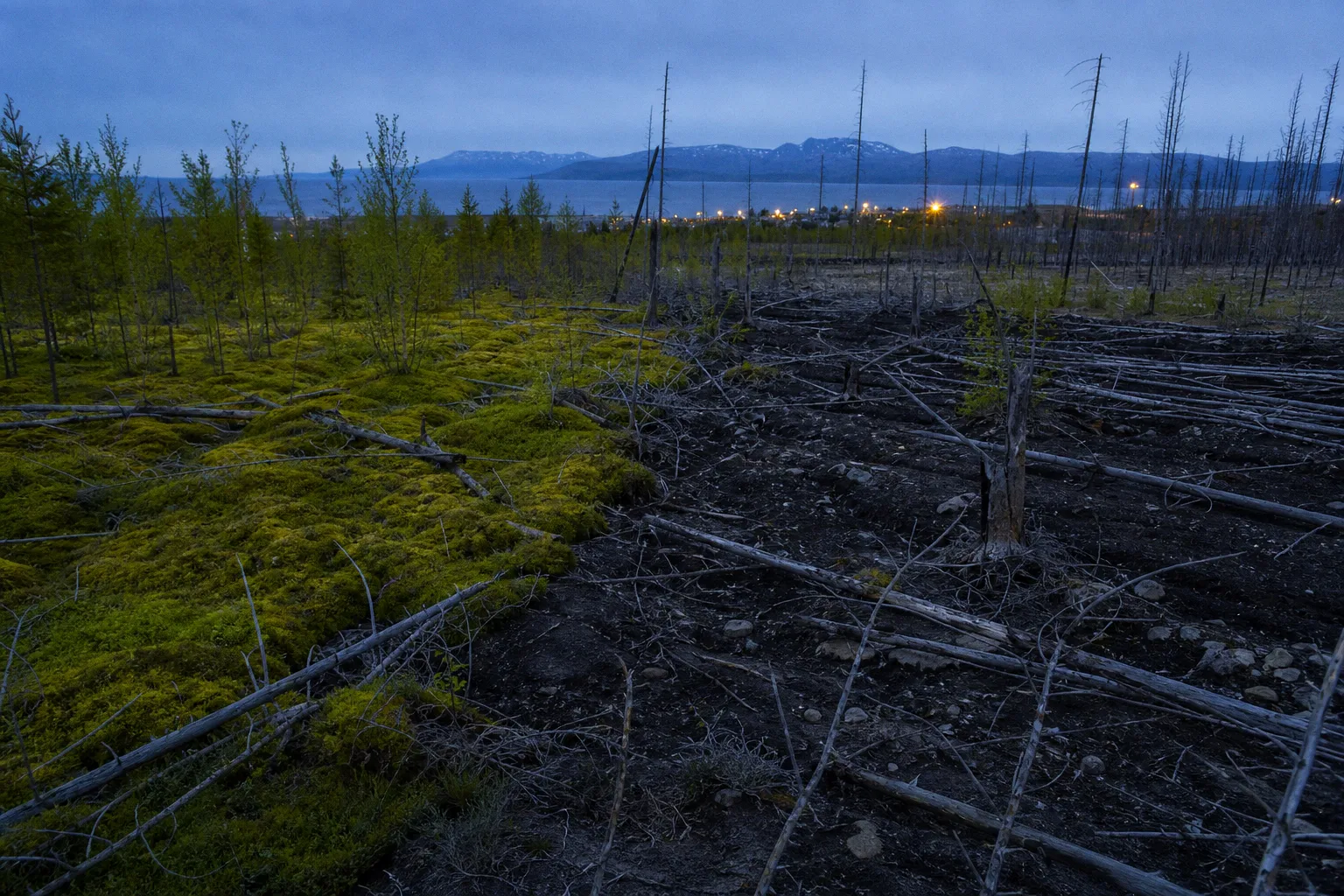
The central anomaly is this: the Arctic-boreal zone is getting greener, yet large parts of it are losing their function as a climate buffer. A 2025 assessment led by the Woodwell Climate Research Center found that 34% of the Arctic-boreal zone has become a net carbon source. Add wildfire emissions, and the share rises to 40%. This is the operating paradox behind the most consequential climate change effects on environment in northern forests: more visible vegetation does not necessarily mean more carbon storage.
The boreal system is not collapsing in a cinematic sense. It is being rebalanced by heat, water stress, microbial activity, fire, logging, and thaw. The gears are visible. The question is whether policy, carbon accounting, and land management can read them fast enough.
The Great Migration: northward expansion and the greening paradox
The boreal forest — the great coniferous belt across Alaska, Canada, Scandinavia, and Russia — has always been constrained by temperature. Warming loosens that constraint at the northern margin. Longer growing seasons allow shrubs and trees to colonize areas where cold once imposed a hard ceiling. Satellite observations from 1985 to 2020 confirm this: tree cover gains are concentrated between 64° and 68° north.
That is the clean part of the signal. The messy part begins when greening is mistaken for recovery.
Across the Arctic-boreal zone, 49% of the landscape is greening, meaning vegetation cover has increased. But only 12% of those greening areas show an annual net increase in CO₂ uptake. That gap is the story. Leaves and needles are easy to see from orbit. Soil respiration is not. Permafrost thaw is not. Microbial decomposition in warming ground does not advertise itself in a satellite image with the same clarity as a new canopy.
The result is a systems-level divergence: the surface looks more productive while the subsurface becomes more emissive. This is not a contradiction. It is a feedback loop.
A warmer growing season can increase photosynthesis. The same warming can accelerate microbial breakdown of organic matter in soils. If the second process outpaces the first, the system greens and still emits more carbon. In a slow-moving biome, that is structural friction: vegetation responds on one timetable; soils and fire regimes respond on another; carbon accounting often lags both.
Greening is a visual metric. Carbon balance is a systems metric. Confusing the two is how northern forests become a policy mirage.
The northward shift also does not mean the boreal forest is simply relocating intact. The southern edge is under different pressure: drought stress, insect outbreaks, heat anomalies, and fire. The exact rate of southern contraction remains uncertain, but the asymmetry is already clear. Expansion at the cold frontier is not automatically equivalent to loss, degradation, or combustion at the warm frontier.
A young stand at the northern margin is not a mature southern stand. It holds less biomass, sits on different soils, and faces a growing fire probability. The biome may expand in area while degrading in function. That is the distinction carbon markets and national inventories have to confront.
The carbon flip: why the boreal biome is becoming a source, not a sink
The boreal forest has long been treated as one of the planet’s major carbon assets. That framing is still partly true. It is also increasingly incomplete.
The biome represents about 20% of the total global forest carbon sink. But its carbon is not primarily in trees. Boreal vegetation stores roughly 38 petagrams of carbon. Boreal soils store approximately 1,672 petagrams, much of it locked in frozen ground. The ratio matters. A policy model focused on trunks and canopy misses the primary reservoir.
| Carbon pool or process | What is changing | Why it matters |
|---|---|---|
| Northern tree cover | Expanded by 0.844 million km² from 1985 to 2020 | Increases visible vegetation, especially near 64–68° N |
| Vegetation carbon | About 38 Pg stored in trees and plants | Important, but small compared with soil carbon |
| Soil carbon | About 1,672 Pg stored in boreal soils | The dominant reservoir; vulnerable to thaw and decomposition |
| Arctic-boreal carbon balance | 34% is now a net carbon source | Indicates a structural shift, not a local anomaly |
| Wildfire-adjusted balance | Source area rises to 40% when fire emissions are included | Fire turns episodic disturbance into a major carbon multiplier |
The carbon flip is driven by several mechanisms acting together.
First, warmer temperatures lengthen the growing season. That can help trees grow where moisture remains adequate. But it also gives microbes more time to decompose organic matter. Soil respiration increases. In permafrost zones, thaw exposes previously frozen carbon to microbial activity. The system begins to unlock its own archive.
Second, water stress is rising at the southern boreal margin. Coniferous forest ecosystem changes are not only about temperature. They are about vapor pressure deficit, soil moisture, snowpack, and the timing of spring melt. Heat without water does not produce stable growth. It produces stress, mortality risk, and fuel.
Third, fire regimes are changing. Fires in boreal forests are not new; they are part of the system’s renewal architecture. But hotter, drier conditions alter frequency, severity, and area burned. More severe fires can combust organic soil layers, not just aboveground vegetation. That matters because boreal soil is the real bank.
Fourth, harvest pressure and land management can weaken the sink. This is not a moral argument against all forestry. It is an accounting argument. Removing biomass, shortening rotation periods, draining peatlands, and disturbing soils can change the sign of a national land sector even where trees continue absorbing carbon.
These are cascading effects. They do not need to move at the same speed to produce the same direction of travel. The boreal forest can become greener, younger, more flammable, more northerly, and less reliable as a carbon sink at the same time.
The hidden reservoir: soil carbon vulnerability and permafrost thaw
The most important boreal carbon stock is the least photogenic one. Soil carbon sits below the public narrative because it lacks the intuitive appeal of forests as walls of trees. But in the boreal biome, the ground dominates the balance sheet.
The figure is stark: 1,672 petagrams of carbon in boreal soils, compared with 38 petagrams in trees and vegetation. This asymmetry changes how taiga biome global warming effects should be evaluated. A forest can add trees and still lose climate function if soil emissions rise faster.
Permafrost is central to this mechanism. Frozen soils have acted as a long-duration storage system. Warming changes the physical state of that system. Once thaw begins, organic matter becomes available to microbes. They metabolize it, releasing carbon dioxide and, in wetter anaerobic conditions, methane. The exact future volume released under 1.5°C versus 2°C warming remains uncertain. The direction of risk is not.
There is a tendency in climate communication to treat permafrost as a separate Arctic issue and boreal forests as a forestry issue. That separation is analytically convenient and structurally wrong. The Arctic-boreal zone is an integrated carbon machine. Trees, peatlands, snow cover, fire, hydrology, and microbial respiration are coupled.
The coupling has practical consequences:
1. A longer growing season has two ledgers. It can increase plant growth and carbon uptake, but it can also extend the period of soil microbial activity. Net balance depends on which side accelerates faster.
2. Thaw changes drainage. As ice-rich ground degrades, landscapes can become wetter in some places and drier in others. Wet areas may increase methane risk; dry areas may increase fire risk.
3. Soil disturbance carries a larger penalty than canopy disturbance alone. If management or fire exposes organic layers, the carbon loss can exceed what is visible in aboveground biomass.
4. Recovery timelines are mismatched. Vegetation can reestablish within decades. Deep soil carbon can take centuries to rebuild, if it rebuilds under the new climate state at all.
This is why environmental shifts in northern forests should not be read as a simple land-cover transition. The more precise term is state change. Not all state changes are abrupt. Some are cumulative, distributed, and hard to reverse because they are driven by feedback loops rather than a single shock.
The wildfire multiplier: when disturbance becomes an emissions engine
Fire is the boreal system’s most visible accelerator. It converts slow ecological stress into immediate atmospheric carbon.
When wildfire emissions are added to the Arctic-boreal carbon balance, the share of the region functioning as a net source rises from 34% to 40%. That six-point increase is not a rounding error. It is the signal of disturbance becoming a macro-scale carbon variable.
Boreal fire differs from many temperate forest fires because of the organic soil layer. In severe burns, combustion can reach into peat and duff. That releases carbon accumulated over long periods. It also alters post-fire recovery by changing soil insulation, moisture, seedbeds, and permafrost stability. Fire can trigger thaw; thaw can change hydrology; altered hydrology can influence the next fire cycle. This is the feedback architecture.
The wildfire multiplier operates through four channels:
- Direct combustion of biomass. Trees, shrubs, and surface vegetation release stored carbon quickly.
- Combustion of organic soils. Severe fires can burn carbon pools that took centuries to accumulate.
- Post-fire decomposition. Dead material that does not burn immediately can decompose over subsequent years.
- Albedo and permafrost effects. Loss of canopy and ground insulation can change surface energy balance and accelerate thaw.
The carbon consequence depends on fire severity, frequency, and recovery interval. A boreal forest can recover from fire if enough time passes before the next severe burn. But climate change compresses that recovery window. Young forests burn differently, regenerate differently, and store less carbon than mature stands.
Young stands up to 36 years old now make up 15.4% of boreal forest area. They hold between 1.1 and 5.9 petagrams of aboveground biomass carbon and could sequester an additional 2.3 to 3.8 petagrams if allowed to mature. That conditional phrase carries the structural risk. Maturation is not guaranteed in a hotter, drier, more fire-prone system.
The boreal carbon sink increasingly depends on a bet: that young forests will live long enough to become old forests. Fire is making that bet less conservative.
This is where public attention often fails. The news cycle can track a catastrophic fire season; it is less capable of tracking the lost maturation pathway that follows. The same media logic that helps audiences navigate fragmented viewing through streaming guides and TV schedules is poorly matched to ecological time. Fire is episodic. Carbon debt is cumulative.
The Finland case study: managed forests and the accounting trap
Finland is useful because it removes an easy excuse. This is not a distant frontier with weak institutions and no monitoring capacity. It is a highly managed forest country with sophisticated inventories and a long forestry tradition. Yet Finland’s forests and land sector have exposed a hard accounting problem.
Finland’s forests were historically a major carbon sink. Since 2021, the land sector has shifted into net emissions. The drivers include rising temperatures, peatland emissions, slower growth, and high harvest levels. Annual harvests have averaged about 72 million cubic meters over the past decade.
The critical distinction: this does not mean Finnish forest trees have stopped absorbing carbon. Trees remain a sink. The overall land sector has flipped because the broader system — soils, peatlands, harvest removals, and growth rates — no longer balances in the same direction.
That distinction matters for climate policy. A country can point to forest cover and still lose sink capacity. It can plant trees and still emit from peat soils. It can maintain a timber economy and still face a deteriorating land-use carbon account. The old shorthand — more forest equals more sink — is no longer adequate in a warming boreal zone.
Finland also illustrates how managed forests can become structurally younger. Shorter rotations increase the share of stands that are growing but not yet storing carbon at mature-forest levels. Younger stands can be vigorous annual absorbers, but the system-level carbon stock depends on harvest timing, product lifetimes, substitution effects, soil emissions, and disturbance risk.
This creates a policy trap. Governments want forests to do three jobs at once:
1. Supply timber and fiber for construction, paper, packaging, and bioenergy.
2. Store more carbon to meet national and international climate targets.
3. Withstand rising disturbance from heat, pests, drought, and fire.
Those objectives are not automatically compatible. They can be aligned only under constraints: lower pressure on vulnerable peatlands, longer rotations where carbon storage is prioritized, protection of high-carbon old stands, and credible accounting for emissions from soils and harvested wood products. Without those constraints, the forest becomes a spreadsheet solution that fails in the field.
Why boreal forest climate change impacts are difficult to price
The boreal shift is not a single environmental problem. It is a compound risk class. That is why markets and policy instruments struggle with it.
A carbon credit methodology can estimate growth in a project area. A national inventory can track land-use categories. A satellite can detect greening. A forestry model can project yield. Each tool captures part of the system. None fully resolves the interaction between thawing soil, fire severity, hydrology, microbial respiration, and management pressure at biome scale.
The measurement challenge is especially acute because boreal carbon is slow to accumulate and fast to release. A mature stand may represent decades of growth. A severe fire can return much of that carbon to the atmosphere in days or weeks. Permafrost carbon accumulated over centuries can become vulnerable once thaw thresholds are crossed. This temporal asymmetry should dominate risk assessment.
The policy implications are direct:
- Do not treat greening as a proxy for sequestration. The 49% greening figure is not evidence of a stronger sink when only 12% of greening areas show net CO₂ uptake gains.
- Separate vegetation carbon from soil carbon. The vegetation pool is large in human terms, but small relative to boreal soils.
- Account for fire explicitly. Excluding wildfire emissions understates the share of the Arctic-boreal zone acting as a source.
- Protect carbon-dense soils. Peatlands and permafrost-affected soils are not interchangeable with ordinary forest land.
- Evaluate harvest levels against sink capacity, not just forest area. A stable or expanding forest estate can still lose carbon function.
The deeper problem is that boreal change is often narrated as migration. That is too simple. Migration implies continuity across space. The observed pattern is more like reconfiguration. Northern expansion, southern stress, soil emissions, and fire do not assemble into a stable replacement system. They produce a new operating regime.
The structural conclusion: the boreal forest is not a backup plan
The boreal biome has warmed by 1.4°C over the past century, the fastest warming of any forested biome on Earth. That rate is enough to change the rules under which the forest became a carbon sink in the first place.
The common climate assumption has been that northern forests would partially cushion human emissions as temperatures rise: longer growing seasons, more vegetation, more uptake. That assumption now requires heavy qualification. The boreal forest is still absorbing carbon in many places. It is still expanding at its northern edge. Young stands still have sequestration potential if they mature. But the system is also emitting from thawing soils, burning more consequentially, and losing sink reliability in managed landscapes.
This is the practical meaning of climate change effects on environment in the boreal zone. They are not limited to species ranges or forest cover maps. They alter the carbon function of an entire biome.
The analytical error to avoid is optimism by aerial view. From above, the forest line moves north and the tundra greens. In the carbon balance, the ground warms, microbes accelerate, peatlands leak, fires intensify, and managed forests face arithmetic they can no longer soften with broad claims about sustainability.
The boreal forest is not disappearing. That is not the right diagnosis. It is becoming less predictable, less stable, and less available as a passive sink for industrial emissions. Climate strategy cannot assume that the northern forest will quietly absorb the surplus. The system is already returning part of the bill.