Xavier Pennington, Lead Columnist, Systems & Macro-Trends
July 11, 2026 · 10 min read
What are the climate change effects on global food security?
Between now and 2050, the global agricultural system is projected to lose between 7% and 24% of its baseline productivity for maize, wheat, and soybeans if current emissions trajectories hold and adaptation remains fragmented.
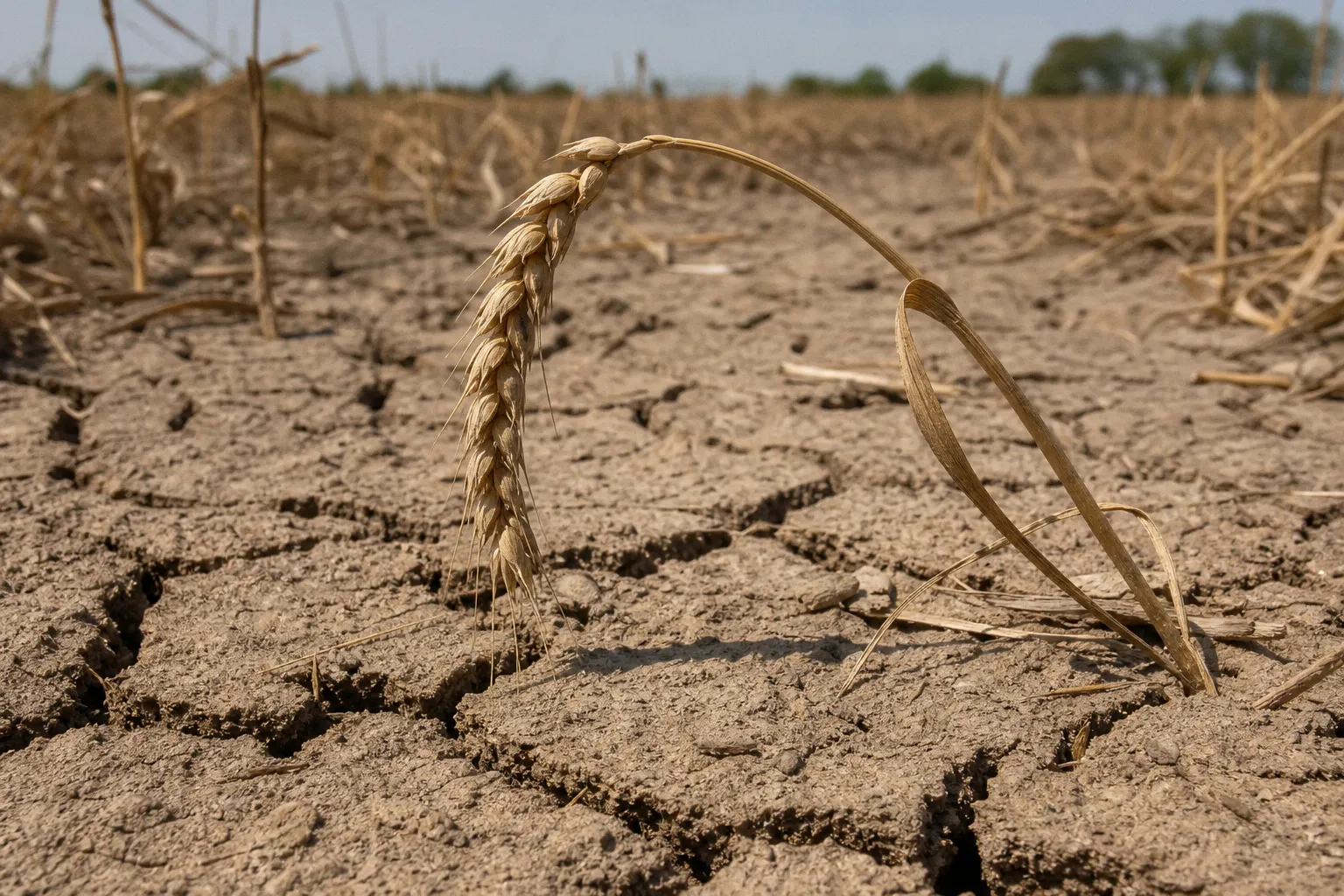
The Slow Compression of Global Caloric Output
For analysts of food systems, the question has shifted decisively. Climate change is not a future variable in the food security equation; it is the active coefficient. The remaining analytical work concerns how the underlying mechanics—rising temperatures, altered precipitation patterns, elevated atmospheric carbon concentrations, and ocean thermal shifts—translate into cascading effects on what people eat, how much of it exists, and where it can be reliably sourced.
The Mechanics of Yield Decline: Maize, Wheat, and Soybeans
The projected 7–24% decline is not a uniform event. It is the aggregated output of several interacting stressors, each operating on different biological timescales and converging into a single measurable reduction in harvested tonnage per hectare.
Temperature operates as the primary catalyst. Maize, in particular, exhibits a sharply nonlinear response to heat: above roughly 30°C, pollen viability collapses, kernel set fails, and yield curves bend downward faster than linear extrapolation would predict. Wheat tolerates a broader thermal envelope but suffers accelerated phenological development under warming—grain-fill periods compress, and the plant simply has less time to convert sunlight into biomass. Soybeans sit somewhere between, sensitive to both daytime heat and nighttime minima that fail to provide recovery windows.
Precipitation interacts with these thermal sensitivities through two distinct channels. In temperate breadbaskets—the U.S. Midwest, Northern China, Ukraine, parts of the European Union—shifting rainfall patterns introduce episodic drought stress during critical reproductive stages. In tropical and subtropical zones, the dominant signal is often excess moisture: intense rainfall events disrupt planting calendars, waterlog root systems, and create conditions for fungal proliferation.
| Stressor | Primary Mechanism | Most Affected Crop | Yield Sensitivity |
|---|---|---|---|
| Heat above 30°C | Pollen sterility, shortened grain-fill | Maize, wheat | High nonlinear |
| Drought during reproductive stage | Water stress at pollination | Maize, soybeans | High |
| Excess moisture / flooding | Root anoxia, fungal disease | All three | Moderate–High |
| Elevated CO2 (alone) | Partial photosynthetic offset | Wheat, soybeans | Low–Moderate |
The final row deserves attention because it explains why CO2 fertilization does not cancel the damage. Elevated atmospheric carbon does stimulate photosynthetic rates in C3 crops (wheat, soybeans) under controlled conditions, but the field-realized offset is substantially smaller than chamber studies suggest—often 50% or less of the theoretical gain—because nutrient limitations, water stress, and heat override the carbon benefit.
The 7–24% figure is not a worst case. It is a central estimate contingent on adaptation proceeding at current rates of investment and deployment.
Nutritional Erosion: How Rising CO2 Levels Diminish Crop Quality
Yield decline captures only the volume problem. A parallel and equally consequential process is degrading the nutritional density of what is actually harvested. Elevated CO2 concentrations are linked to measurable reductions in protein, zinc, and iron content across major cereal crops, with rice and wheat showing the most consistent declines in field trials.
The mechanism is biochemical. Under elevated CO2, plants accumulate greater biomass but dilute their concentration of nitrogen-based compounds—including amino acids and the proteins built from them. Micronutrient dilution follows a similar pattern: zinc and iron concentrations fall as carbohydrate accumulation outpaces mineral uptake from soil reserves.
For populations already consuming near subsistence-level diets, this is not a marginal nutritional footnote. It is a structural erosion of dietary quality at scale. A person eating the same mass of grain may receive substantially less protein and fewer critical micronutrients per calorie consumed. The implications cascade into childhood stunting, anemia prevalence, and immune function—outcomes that do not register as "food insecurity" in headline hunger statistics but constitute a parallel crisis of nutritional insecurity.
This dynamic also inverts a common assumption about food system progress. Historically, crop breeding programs have delivered gains in both yield and nutritional content. Climate change is decoupling those two curves: caloric output may continue rising in some high-input systems while nutritional density quietly declines.
Extreme Weather as a Catalyst for Global Hunger and Price Volatility
Yield trajectories represent the slow-moving baseline. Extreme weather events operate as the acute disruptors, and their frequency and intensity are rising along the emissions curve. Heatwaves, droughts, and floods are now identified as primary drivers of recent increases in global hunger statistics—not because chronic malnutrition has been solved elsewhere, but because these episodic shocks are pushing already-vulnerable populations across thresholds of acute food deprivation.
The transmission mechanism runs through prices. When a major exporter experiences a production shock—Russia's 2010 wheat ban following drought, the U.S. Midwest's 2012 maize collapse, India's multiple rice export restrictions in recent years—global commodity markets reprice within days. Import-dependent nations, particularly in the Middle East and North Africa, absorb those price signals through import bills that can double or triple in compressed timeframes. Domestic political instability often follows within months.
Three structural features amplify this volatility:
1. Concentration of export capacity. A small number of countries and regional breadbaskets supply the majority of globally traded cereals. When two or more experience simultaneous shocks, no offsetting supply exists.
2. Low buffer stocks. Strategic grain reserves have been drawn down since the 2008 food price crisis and have not been rebuilt to historical levels. The system's ability to absorb a shock before prices spike is materially diminished.
3. Financialization of commodity markets. Algorithmic trading and index fund participation accelerate the speed at which physical supply disruptions translate into price movements, often amplifying the magnitude.
The result is a food system that is simultaneously more productive on average and more prone to acute volatility—a destabilizing combination for the roughly 800 million people already classified as chronically undernourished, and a threat multiplier for the additional millions projected to enter that category by 2050.
The Blue Crisis: Ocean Warming and the Future of Global Protein Sources
Land-based agriculture captures most of the analytical attention, but the food security picture is incomplete without addressing what is happening in the oceans. Fisheries and aquaculture provide essential protein for over 3 billion people, and they are absorbing climate stress through two distinct channels: thermal shifts that relocate fish stocks, and acidification that disrupts the base of the marine food web.
Ocean warming pushes species toward the poles at rates of 50–70 km per decade in many commercial fisheries. This redistribution does not eliminate catches globally—it concentrates them. Tropical and subtropical fishing nations, many of which are low-income and food-insecure, lose access to species that migrate beyond their exclusive economic zones. Wealthier nations with longer coastlines and deeper-water fleets absorb the migration. The result is a quiet but significant transfer of protein access from vulnerable to better-resourced populations.
Aquaculture, often cited as the adaptive solution, faces its own constraints. Marine finfish farming depends on wild capture fisheries for feed inputs, and those feed-fish stocks are themselves climate-stressed. Freshwater aquaculture—dominated by carp, tilapia, and catfish—faces thermal extremes and water availability challenges that mirror those confronting terrestrial agriculture.
Acidification operates on longer timescales but represents a deeper structural risk. As oceans absorb roughly 25% of anthropogenic CO2 emissions, pH levels decline and carbonate saturation drops. Shellfish, corals, and the pteropods that anchor many pelagic food webs struggle to build and maintain calcium carbonate structures. The productive base of marine ecosystems is being undermined at the chemical level, with consequences that will play out over decades regardless of near-term mitigation success.
Protein security is not a terrestrial question. Roughly 3 billion people depend on marine sources for a substantial share of their animal protein intake—and that supply architecture is undergoing thermal relocation and chemical destabilization simultaneously.
Regional Vulnerabilities and the Threat Multiplier Effect
Climate change does not impact food systems uniformly, and the regional distribution of risk reveals the structural inequalities embedded in the global food economy. Sub-Saharan Africa and South Asia are consistently identified as the most vulnerable regions, and the underlying causes extend beyond simple geography.
Several reinforcing dynamics converge:
- Rainfed dependence. A high proportion of agricultural output in these regions depends on rainfall rather than irrigation, making systems directly exposed to precipitation variability.
- Limited adaptive capacity. Smallholder farmers operating without crop insurance, access to credit, or institutional extension services have fewer tools to respond to changing conditions.
- Baseline nutritional deficits. Populations already consuming below recommended caloric and micronutrient thresholds have less buffer against further shocks.
- Climate-sensitive staple dependence. Crops like millet, sorghum, and rainfed rice—nutritionally critical in these regions—are among the most climate-sensitive in production.
The critical analytical point is that climate change operates as a threat multiplier rather than a sole cause of food insecurity. Economic volatility, conflict, currency instability, and pandemic-era supply chain disruptions all interact with climate stress to compound outcomes. Isolating the climate signal is methodologically difficult and politically uncomfortable—because it distributes responsibility and complicates the policy response.
One common analytical error deserves correction: not all regions face yield declines. Some high-latitude areas—the Canadian Prairies, Northern Europe, parts of Russia—may experience temporary productivity gains from longer growing seasons and warmer temperatures. But these localized gains are more than offset by quality degradation, extreme weather disruption, water cycle changes in adjacent regions, and the systemic risks introduced into globally integrated food markets. Optimism anchored in high-latitude opportunity is, at best, a partial and temporary reprieve.
The Structural Reality of Adaptation
Adaptation is the variable that determines whether the 7–24% yield decline range holds or widens. Climate-smart agriculture, improved seed varieties, precision irrigation, and adjusted planting calendars represent genuine technical responses. But their deployment is uneven, and the pace of adoption in the regions facing the greatest exposure lags significantly behind the pace of climate change itself.
The structural friction is familiar to anyone who has studied technology diffusion in low-income agricultural systems: input costs, information asymmetries, supply chain gaps, and risk aversion among smallholders operating close to subsistence. These are solvable problems—witness the dramatic productivity gains in parts of East Africa following targeted investment in improved seed systems and mobile-enabled agronomic advisory services. But they are not self-solving, and they require sustained capital deployment and institutional support that have historically been underprovided.
Food waste represents a parallel and immediate lever. Roughly 30% of global food production is lost or wasted annually—a figure that, if even partially addressed, would offset a meaningful share of the projected climate-related supply compression. Yet waste reduction has received a fraction of the policy attention and capital flow directed toward supply expansion, despite offering a faster return on investment and immediate emissions benefits.
The Inescapable Interconnection
The climate–food security nexus cannot be decomposed into a single causal chain. It is a system of feedback loops where rising temperatures degrade yields, degraded yields tighten supply, tightened supply raises prices, raised prices push vulnerable populations into acute hunger, and the political and economic instability that follows reduces the capacity to mount adaptive responses. Each loop reinforces the others.
For analysts, the operational implication is clear: food security policy that treats climate change as a background variable will fail. Climate policy that treats food systems as a downstream consequence will also fail. The two are now structurally inseparable, and the analytical frameworks—let alone the policy frameworks—must reflect that interconnection with more rigor than current institutional architectures typically provide.
The range between 7% and 24% is not destiny. It is a function of choices made over the next two decades about emissions trajectories, adaptation financing, trade architecture, and the political willingness to treat food security as a global public good rather than a market externality. But under any realistic scenario, the system that emerges from the next quarter-century will look materially different from the one that preceded it. The question is whether it will be different in ways we have planned for, or different in ways we have merely observed.