Challenges of Geopolitical Risks in Global Supply Chains
A thin evidence cluster is enough to expose a larger market problem: geopolitical risk is no longer a background variable in supply chains.
Xavier Pennington, Lead Columnist, Systems & Macro-Trends·updated July 15, 2026
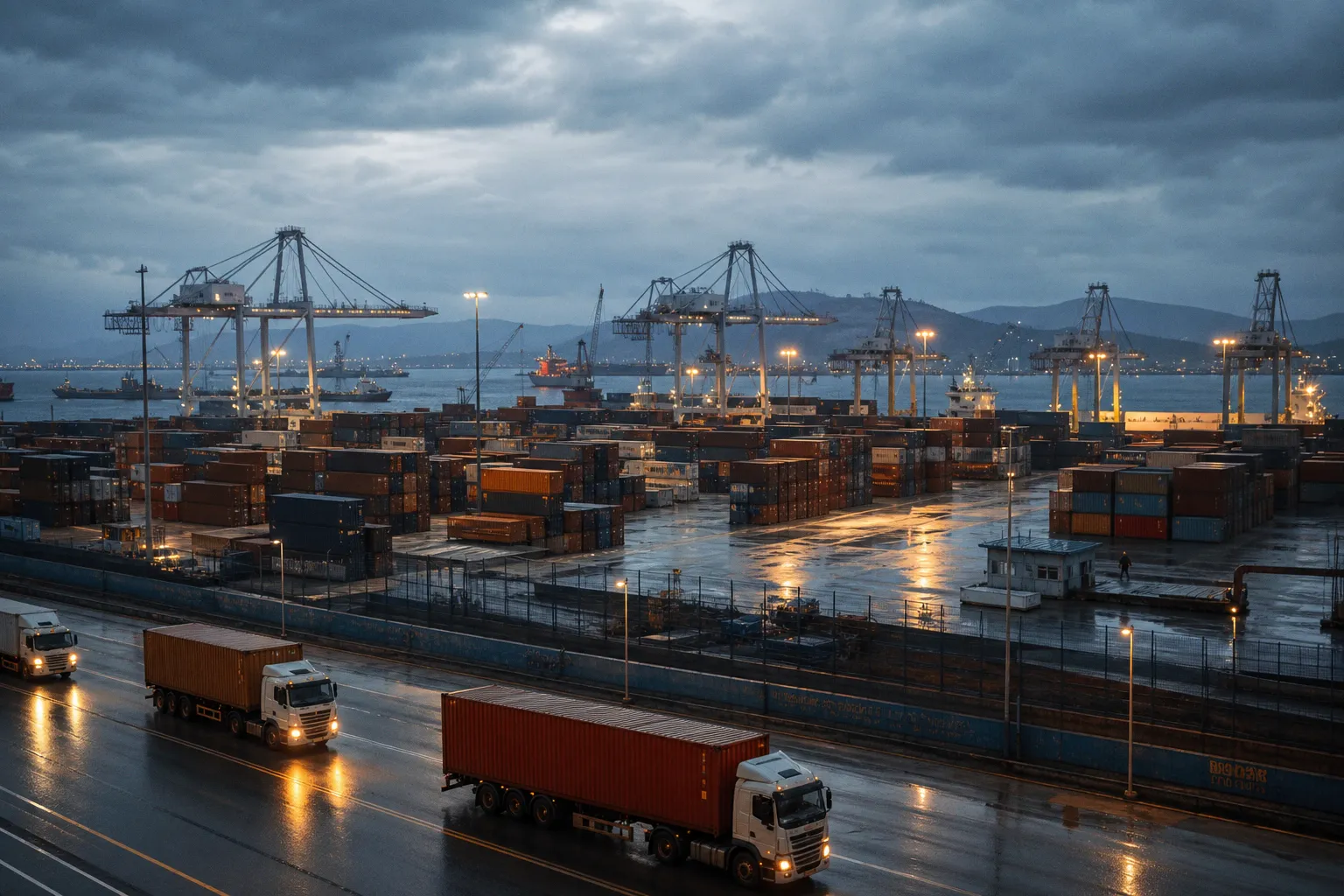
Supply chains are being priced against politics, not just distance
The immediate news is narrow: an aftermarket-sector source is pointing to geopolitical risk as a supply-chain challenge. The available snippet does not provide company names, cost figures, route data, or specific disruption events, so the responsible reading is limited. But the framing itself matters.
For market operators, “geopolitical risk” is not a slogan. It is a category of uncertainty that changes how inventory, procurement, and contracts are evaluated. A supplier may still exist. A route may still function. A price may still look stable. The problem is the probability distribution around all three.
That is where the aftermarket angle becomes relevant. Aftermarket businesses are exposed to timing. Parts, components, replacement cycles, and distributor networks depend on availability at the point of need. When politics becomes a supply-chain input, the system gains a new feedback loop: uncertainty encourages precautionary behavior, precautionary behavior alters demand patterns, and altered demand patterns can create further stress in distribution.
We should not infer more than the source states. But we can identify the practical question it raises: whether firms are treating geopolitical risk as an exceptional disruption or as a standing operating condition.
Inflation relief does not remove political risk
TradingView’s separate signal is useful because it cuts against a common market simplification. Romanian inflation is reported to have begun falling, yet domestic and global politics are still described as risks. That pairing matters.
Falling inflation can ease pressure on households, firms, and policymakers. But it does not automatically repair the political channels that influence supply chains. Markets often compress “inflation down” into “risk down.” That is too clean. Price momentum and political stability are different mechanisms.
For companies with exposure to cross-border sourcing, the lesson is direct: do not confuse macro relief with operational resilience. A lower inflation trajectory may improve financing conditions or input-cost expectations, but political risk can still affect procurement decisions, payment assumptions, and contingency planning.
This is the core systems point. Supply chains sit at the intersection of physical movement, financial pricing, and political permission. A change in one layer does not neutralize instability in the others. The machinery can look calmer at the dashboard while remaining fragile inside the gears.
The risk map is broader than factories
The Institute for Global Affairs’ item, “The Ugly Politics of the Beautiful Game,” points to a wider pattern: politics now attaches itself to sectors not usually treated as supply-chain indicators. Sport, media, logistics, consumer markets, and manufacturing all sit inside the same geopolitical field. Anyone tracking world football news can see how global industries are increasingly shaped by forces outside the core product itself.
That does not mean football politics and industrial supply chains are identical. They are not. The point is structural: globalized systems depend on cross-border trust, institutional predictability, and the ability to move goods, capital, talent, or attention across jurisdictions. When those conditions become contested, risk migrates.
For readers managing exposure, the practical response is not panic. It is audit discipline. Identify which suppliers, routes, currencies, and regulatory environments are politically sensitive. Separate known costs from uncertain dependencies. Ask whether backup plans are real or merely documented. And avoid the most expensive assumption in global operations: that yesterday’s low-friction system is still the baseline.
The available facts do not support a dramatic conclusion. They support a disciplined one. Geopolitical risk is being discussed across supply chains, inflation analysis, and global cultural industries because it has become a connective tissue of the market system. The task now is to measure it before it becomes visible in failure.