EU Foreign Affairs Committee Wraps Up High-Level Diplomatic Mission to China
According to the European Parliament, its Foreign Affairs Committee has completed a three-day mission to Beijing and Shanghai—the first such visit since direct contacts between Parliament and Chinese…
Xavier Pennington, Lead Columnist, Systems & Macro-Trends·updated July 25, 2026
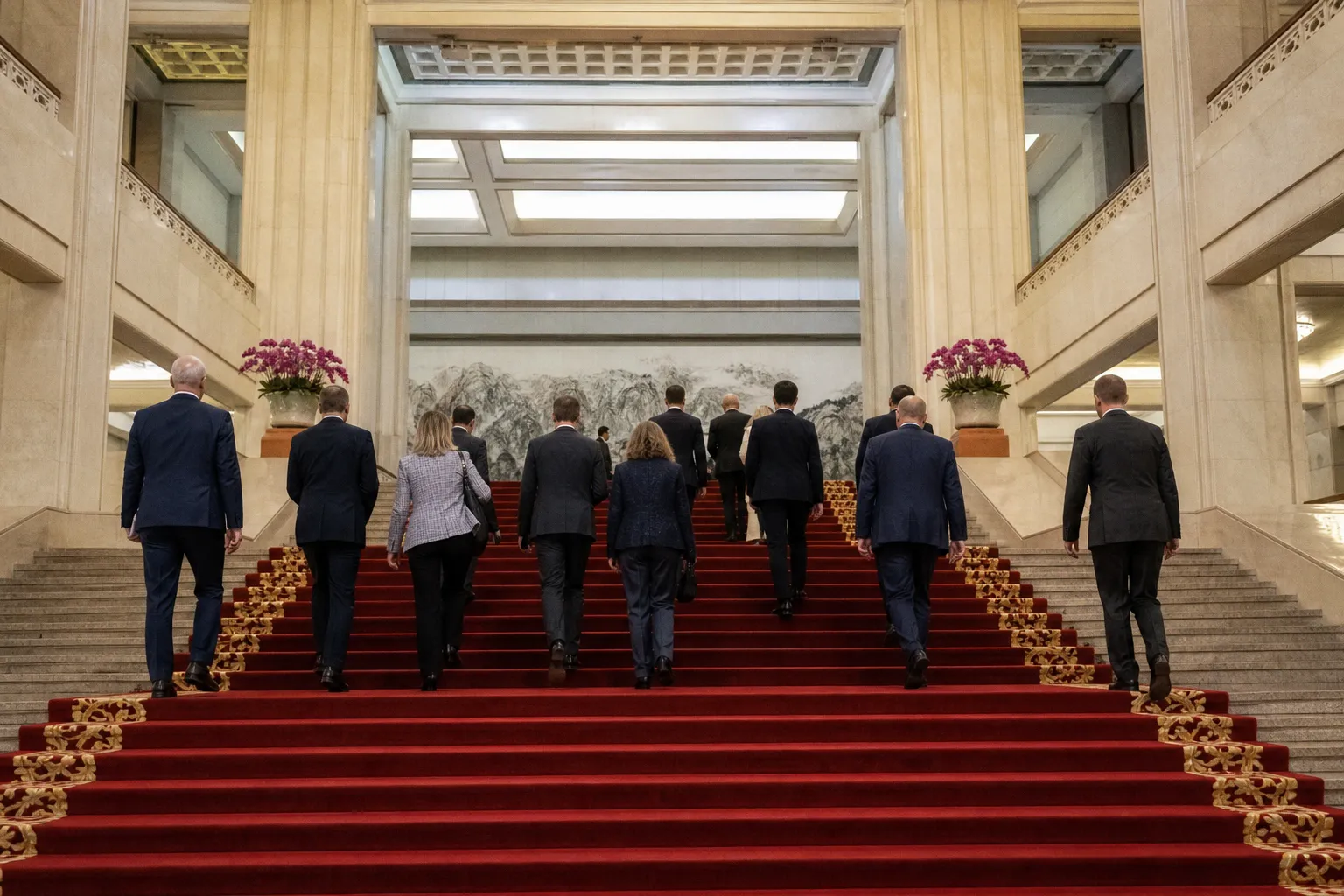
According to the European Parliament, its Foreign Affairs Committee has completed a three-day mission to Beijing and Shanghai—the first such visit since direct contacts between Parliament and Chinese authorities resumed last year. The delegation, led by committee chair David McAllister, met Foreign Minister Wang Yi and other senior Chinese counterparts. Its significance lies less in diplomatic theatre than in the policy machinery now being set in motion: formal parliamentary recommendations on EU–China political relations are due in autumn 2026.
Dialogue has restarted, but the friction points remain intact
The delegation’s itinerary mapped the full operating environment of the relationship. In Beijing, MEPs met Wang Yi, leaders of the National People’s Congress, Chinese Communist Party representatives, diplomats from the EU and member states, business representatives and academics. In Shanghai, they met municipal authorities and viewed practical applications of AI.
That breadth matters. EU–China relations are no longer a narrow foreign-policy file; they are a system linking security, trade, technology, climate policy and institutional dialogue. The mission explicitly addressed geopolitical implications, while both sides underlined the value of multilateralism and the UN Charter. But agreement on the framework does not resolve disagreement within it.
The committee pressed China to use its influence on Russia in support of a ceasefire in Ukraine and a just peace grounded in the UN Charter and Ukraine’s sovereignty and territorial integrity. It also repeated its call for China to stop transfers of dual-use goods and components to entities supporting Russia’s war. This is the central structural friction: Europe is attempting to preserve dialogue with Beijing while defining the security conditions under which that dialogue can retain political credibility.
Trade is the hard metric behind the diplomatic language
The committee described the EU’s trade deficit with China as having reached a record €1 billion per day. MEPs called the situation unsustainable and argued for reciprocity, a level playing field and trust.
This is the concrete market anomaly that will shape the autumn recommendations. A relationship can be labelled stable and balanced, as both sides suggested it should be. Yet stability has to survive an expanding commercial imbalance. The Parliament’s language indicates that trade is not being treated as a separate technical dispute; it is part of the wider feedback loop between economic exposure, political trust and strategic autonomy.
The inclusion of AI in the mission’s agenda is equally instructive. The delegation discussed responsible AI governance alongside climate action and the green transition, and observed AI applications in Shanghai shortly after the city hosted the World Artificial Intelligence Conference. Technology cooperation is therefore not absent from the relationship. It is being considered alongside governance, competitiveness and geopolitical risk rather than as a self-contained innovation agenda.
The autumn recommendations are the next meaningful test
The visit produced no announced settlement. It did, however, restore a channel that the committee says it hopes can become more regular and results-oriented. That is a limited but important institutional outcome. Regular contact can reduce informational gaps; it cannot, by itself, remove the underlying disputes over Russia, human rights, market access or economic reciprocity.
The practical indicator to watch is the committee’s eventual recommendation package. Its wording will show whether the Parliament converts this mission into a more durable structure for engagement—or whether dialogue remains a thin layer over unresolved strategic divergence.