How Does A Region Become A New Country? Understanding UN Rules, International Law And Global Politics
Since South Sudan gained independence in 2011, the global map has remained frozen — not for lack of separatist ambition, but because the machinery of statehood is structurally designed to resist new entries.
Xavier Pennington, Lead Columnist, Systems & Macro-Trends·updated July 16, 2026
The Montevideo Threshold
International law begins with a deceptively simple checklist. The 1933 Montevideo Convention defines four baseline criteria for statehood: a permanent population, a defined territory, a functioning government, and the capacity to enter into relations with other states. These conditions are necessary — but critically, they are not sufficient. A region can satisfy all four and still exist in diplomatic limbo indefinitely.
Somaliland is the structural proof point. Since declaring independence from Somalia in 1991, it has maintained its own government, held elections, and operated functional institutions. By Montevideo's standard, it qualifies. Yet no major power has extended formal recognition, and it remains absent from the UN's 193-member roster. The convention sets the floor; politics determines who clears it.
The Recognition Gap
The core tension in international law runs between two competing doctrines. Declaratory theory holds that a territory becomes a state the moment it fulfills the Montevideo conditions — recognition by others is acknowledgment of a fact, not a prerequisite. Constitutive theory argues the opposite: without recognition from existing states, sovereignty is a legal fiction.
In practice, the system operates closer to constitutive logic. Kosovo declared independence from Serbia in 2008 and secured recognition from over 100 UN member states. But key holdouts — including China, Russia, and several EU members — keep it outside full international legitimacy. The result is a half-state: functional sovereignty without universal acceptance. This recognition gap is not a bug in the system; it is the system. Each existing state acts as an independent gatekeeper, and their decisions are driven by strategic interest, not legal consistency. Nations with their own separatist concerns — Spain vis-à-vis Catalonia, China vis-à-vis Tibet — have structural incentives to block precedent.
The UN Gauntlet
The United Nations does not create countries. That is a common misconception worth dismantling. Recognition is a sovereign decision made by individual states. But UN membership functions as the strongest available proxy for legitimacy — and its admission process is deliberately prohibitive.
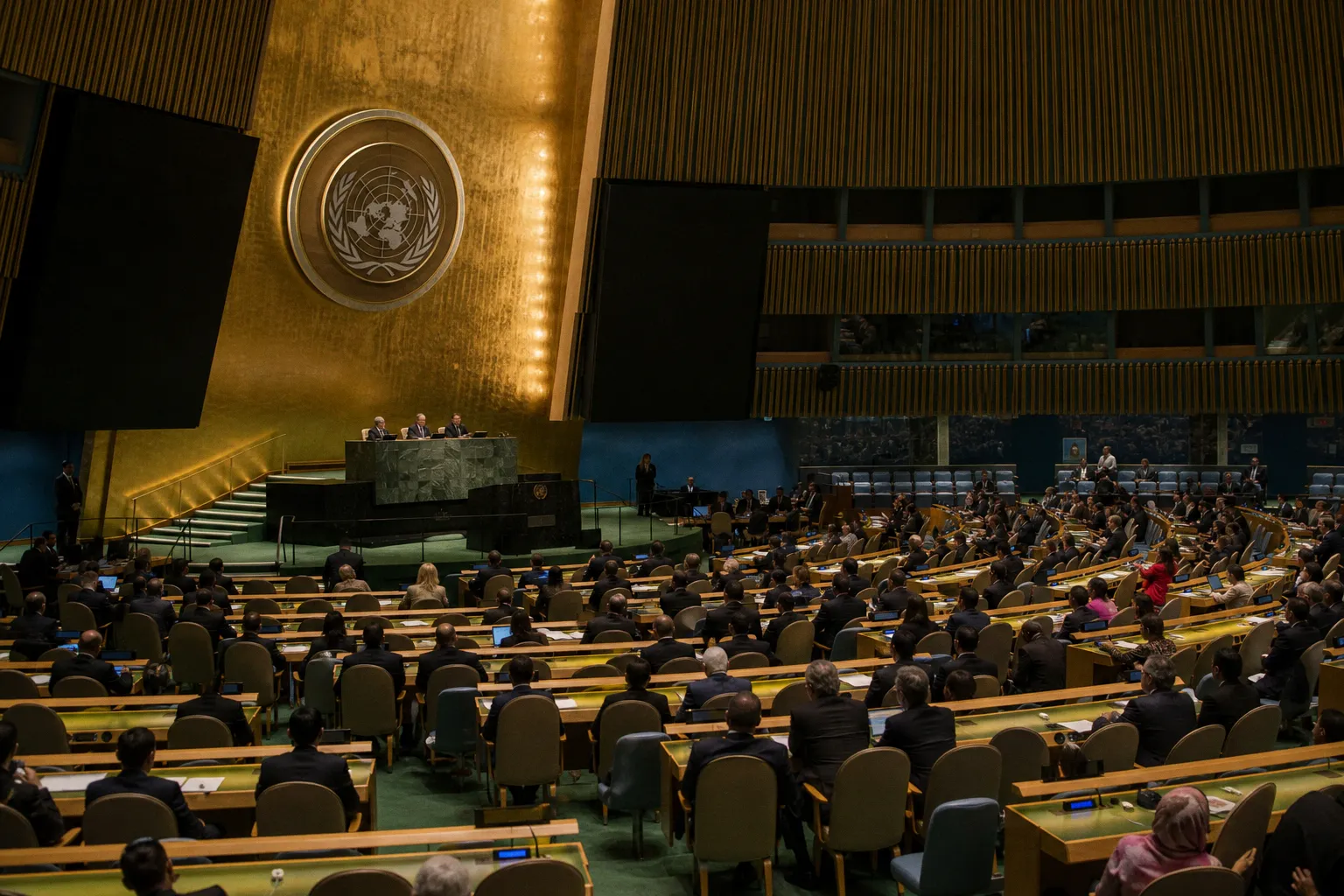
A candidate state first needs approval from the Security Council, where at least nine of fifteen members must vote in favor and none of the five permanent members — the US, Russia, China, France, the United Kingdom — can exercise a veto. A single P5 objection kills the application outright. If the Security Council clears the path, the General Assembly then requires a two-thirds supermajority: 129 out of 193 member states. This dual-gate structure means that geopolitical alignment matters as much as legal standing. A region could meet every Montevideo criterion, secure broad recognition, and still be blocked at the Security Council by a single strategic adversary of one P5 member.
The feedback loop is self-reinforcing. Without UN membership, a new state struggles to access international institutions, treaty frameworks, and the diplomatic infrastructure that sustains sovereignty in practice. Without those resources, its functional capacity erodes — which in turn weakens future bids for recognition. The system privileges incumbency.
What to watch: any new separatist referendum or unilateral declaration — particularly in regions where a P5 member has direct strategic interest — will immediately run into this structural friction. The legal pathway exists on paper. The political pathway remains gated by a handful of capitals whose decisions have little to do with the Montevideo Convention and everything to do with the global balance of power.