Britain's Bold Defence Investment: Transforming Military Strategy for the Future
Britain’s new Defence Investment Plan is not just a spending announcement; it is a signal about where military systems are being forced to evolve.
Xavier Pennington, Lead Columnist, Systems & Macro-Trends·updated July 01, 2026
The spending map shows the hierarchy of priorities
The largest confirmed figure in the reported plan is £63 billion for nuclear deterrents, advanced submarines, and fighter jets. That is the hard backbone of the strategy: survivability, reach, and high-end combat capability.
A second major pillar is the Global Combat Air Programme, backed by £8.6 billion over four years. Britain is pursuing that programme with Italy and Japan, with BAE Systems, Mitsubishi Heavy Industries, and Leonardo identified as leading contractors. The intended output is a new fighter jet.
For related context, see Pioneer Publications Explore Investment In The UK's Innovation Economy.
This matters because the plan is collaborative by design. Britain is not framing modernisation as a purely domestic buildout. It is embedding future capability inside a multinational industrial structure. That creates leverage, but also dependency. Shared development can spread cost and technical burden; it can also introduce coordination friction across governments, contractors, and strategic requirements.
The plan also includes £5 billion for drone development and £2 billion for AI integration, with further investment aimed at autonomous military applications. Those figures are smaller than the nuclear and platform allocations, but they indicate a second operating logic: legacy force structure is being supplemented by software-heavy and unmanned systems.
The real shift is from platforms to systems
The traditional defence debate often fixes on individual assets: the fighter, the submarine, the missile, the transport aircraft. The British plan, as reported, points to a more complex architecture. Combat air, nuclear deterrence, submarines, drones, AI, and autonomy are not isolated buckets. They are interdependent layers.
That is the useful way to read this announcement. The fighter programme is not only about a future aircraft. It is about industrial capacity, sensor integration, software, survivability, and coalition interoperability. Drone funding is not only about unmanned vehicles. It is about changing the cost curve of military operations. AI integration is not only a technology label. It is a bet that decision cycles, targeting, maintenance, surveillance, and autonomy will become decisive sources of advantage.
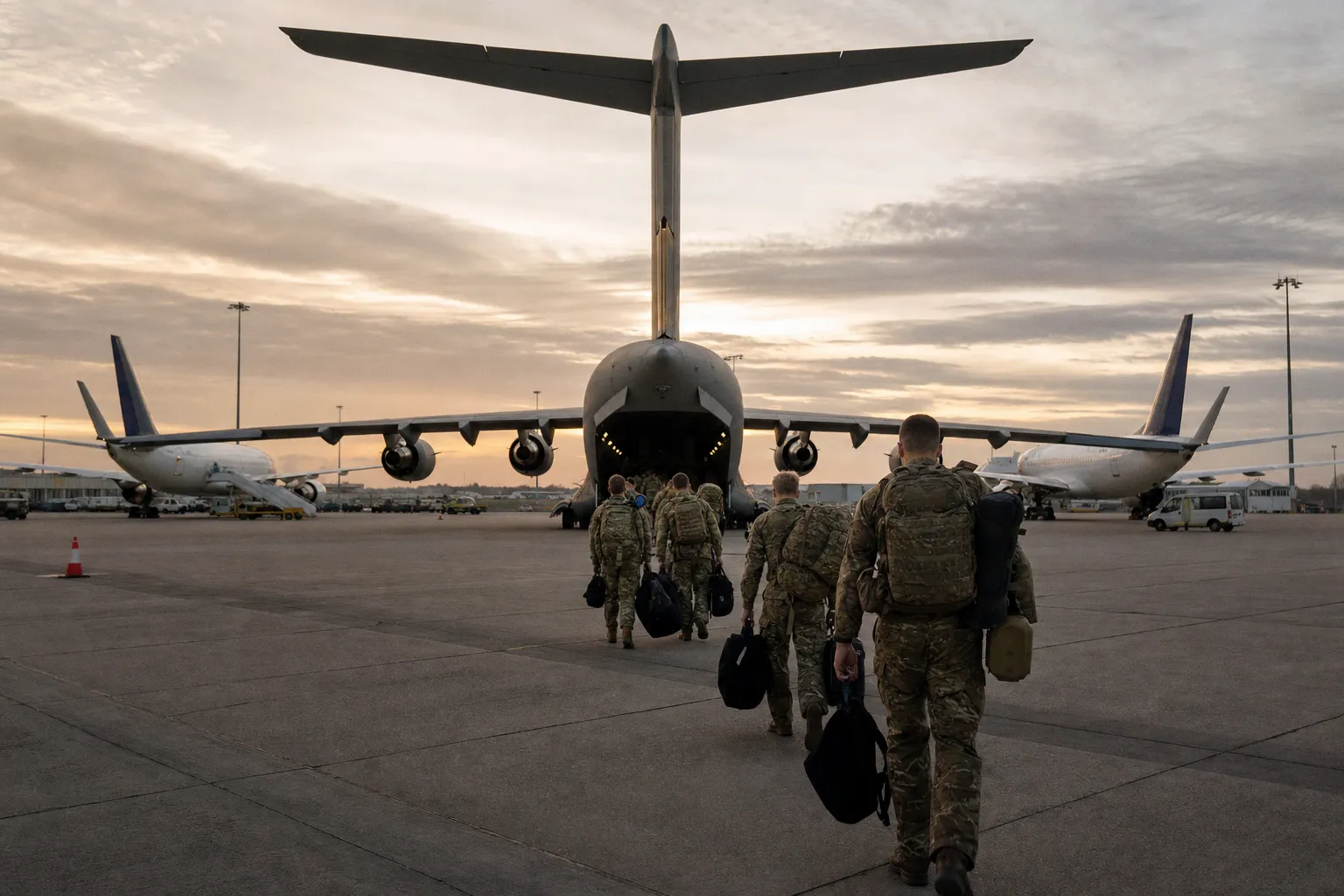
There is also a macro signal here. A separate source in the same news cluster describes the continuing strategic role of the US C-5M Super Galaxy in moving oversized military cargo across intercontinental distances, including heavy combat systems. That report is about the United States, not Britain, but it highlights a broader constraint facing advanced militaries: capability is only useful if it can be moved, sustained, and integrated at scale.
Britain’s plan, therefore, should be assessed less as a headline spending package and more as a test of systems execution. Money is the catalyst. The feedback loop will come from delivery: whether complex multinational programmes, advanced platforms, AI adoption, and autonomous systems can be made operational rather than merely announced.
What to watch next
The first practical checkpoint is the Global Combat Air Programme. The relevant question is not only whether £8.6 billion is allocated over four years, but how the partnership between Britain, Italy, Japan, BAE Systems, Mitsubishi Heavy Industries, and Leonardo is governed. Multinational defence projects tend to expose structural friction early: workshare, requirements, timelines, and export logic.
The second checkpoint is the balance between established deterrence and emerging technologies. The reported £63 billion commitment to nuclear deterrents, submarines, and fighter jets anchors the plan in conventional high-end capability. The £5 billion for drones and £2 billion for AI integration show the adaptive layer. The strategic risk is imbalance: overprotecting legacy systems while under-integrating the technologies meant to change how those systems operate.
The third checkpoint is autonomy. “Further investments” in autonomous military applications are reported, but the available details do not define scale, deployment model, or timeline. That ambiguity matters. Autonomy is not a single procurement category; it is a doctrine problem, an engineering problem, and a command-and-control problem.
For readers tracking global affairs, the important conclusion is restrained but consequential. Britain is not simply spending more on defence. It is attempting to rewire its military-industrial priorities around deterrence, air power, unmanned systems, AI, and international co-development. The plan’s significance will not be proven by the announcement. It will be proven by whether these pieces become a coherent operating system.