Ukrainian drones hit Russian oil sites, fuel crisis pressures Putin
Ukraine's drone campaign has reportedly knocked out up to 17% of Russia's oil refining capacity, targeting the St. Petersburg oil terminal, a military site in Kronstadt, and the Kstovo refinery in Nizhny Novgorod Oblast.
Xavier Pennington, Lead Columnist, Systems & Macro-Trends·updated July 05, 2026
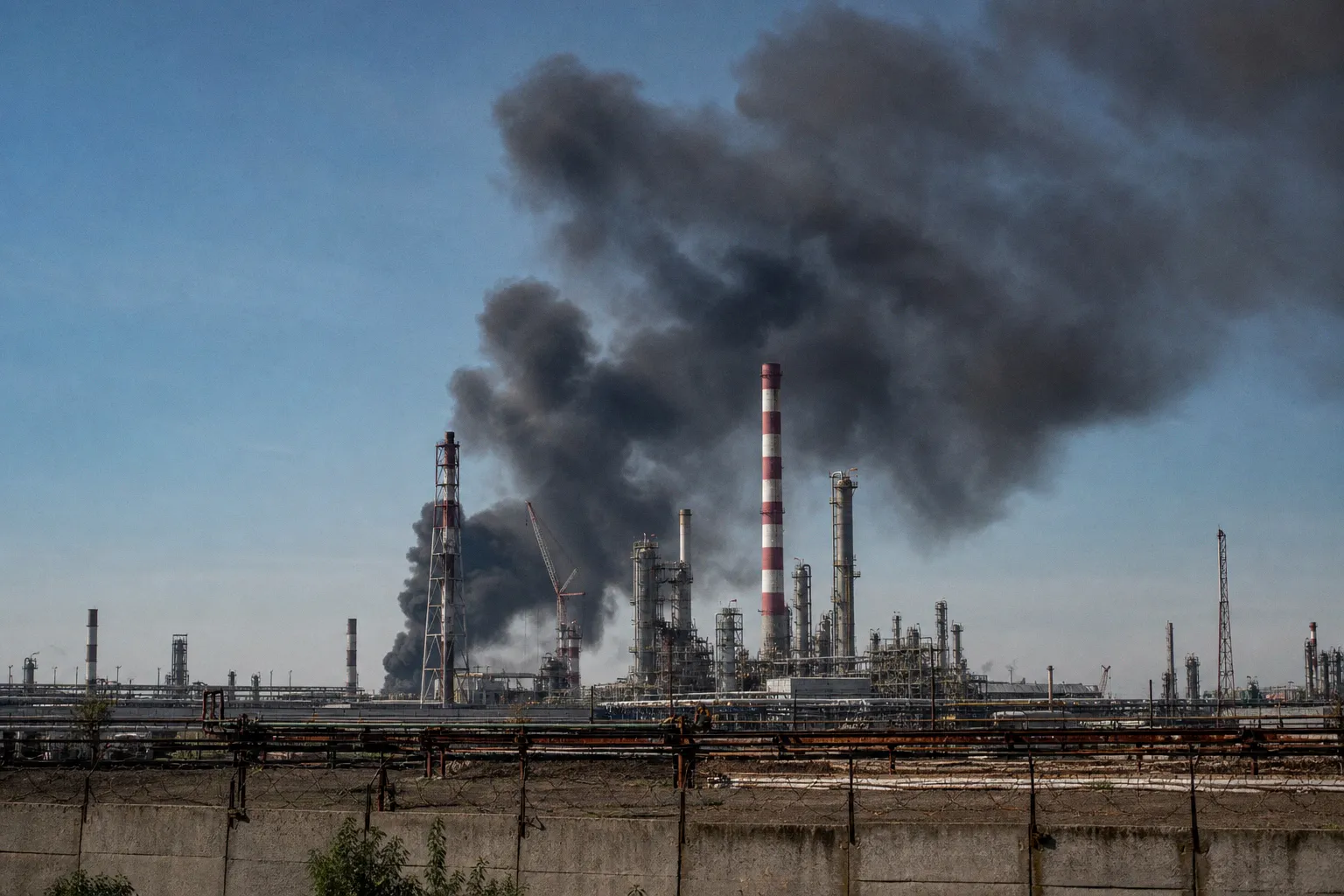
The strike architecture
The pattern is systematic. Ukrainian forces are concentrating fire on downstream nodes rather than upstream production — refineries and terminals rather than wellheads. This creates a compounding constraint: crude can still flow, yet the domestic fuel supply chain narrows at precisely the conversion points that serve military logistics and civilian markets simultaneously. A disruption that removes nearly a sixth of refining capacity does not merely raise prices. It forces rationing logic into a system that has historically avoided it, and rationing logic travels quickly into political pressure on the central government.
The choice of targets — St. Petersburg's terminal, Kronstadt's military infrastructure, Kstovo's AVT-6 unit — suggests a deliberate effort to stretch Russian air defense across geographically dispersed assets. Each strike forces a reallocation of interceptor capacity, generating the kind of structural friction that compounds over weeks rather than days.
The ground offset
The aerial campaign, however, is not operating in isolation. Russian assault groups are now approximately 9 km from the eastern outskirts of Slovyansk — close enough that roughly 40,000 remaining civilians face an immediate evacuation question. Forward units are similarly positioned roughly 9 km from Kramatorsk. On the southern axis, the "Vostok" group has encircled Pokrovske on two sides and advanced toward Hulyaipil's'kyie in Zaporizhia and Dnipropetrovsk oblasts. The Ukrainian counteroffensive in the Stepnohirsk-Plavni area has stalled at Kamyanske.
The tactical picture is hardening. The Ukrainian Air Force lost three MiG-29 fighters last weekend — one shot down in flight, two destroyed at Voznesensk airport by Russian drones, with GBU-39/B small-diameter bombs visible on external pylons in released footage. Aircraft losses of this kind are not recoverable in the short term.
What to track
Three indicators will clarify whether the refinery campaign is generating real political pressure inside Russia or merely tactical noise. First, any mandatory fuel rationing or export restrictions — these would signal that the 17% figure is translating into systemic shortage rather than localized disruption. Second, the Institute for the Study of War's assessments of Ukrainian territorial momentum, particularly in Crimea, where Ukrainian strategy has historically sought to translate logistics pressure into recoverable ground. Third, the tempo of Russian ground advances around Slovyansk and Kramatorsk: if the refinery strikes are forcing Russian command to divert air defense assets westward, the pace of these advances should slow within weeks. If it does not, the drone campaign is exerting pressure on fuel markets without yet restructuring the battlefield.