Xavier Pennington, Lead Columnist, Systems & Macro-Trends
July 17, 2026 · 9 min read
Climate change effects in agriculture: the olive oil lesson
In the 2022/23 campaign, Spain — by a wide margin the world's largest olive-oil producer — extracted 666,000 tonnes. Set against the preceding campaign, the figure represents a 55% collapse in national output.
Climate change effects in agriculture: the olive oil lesson
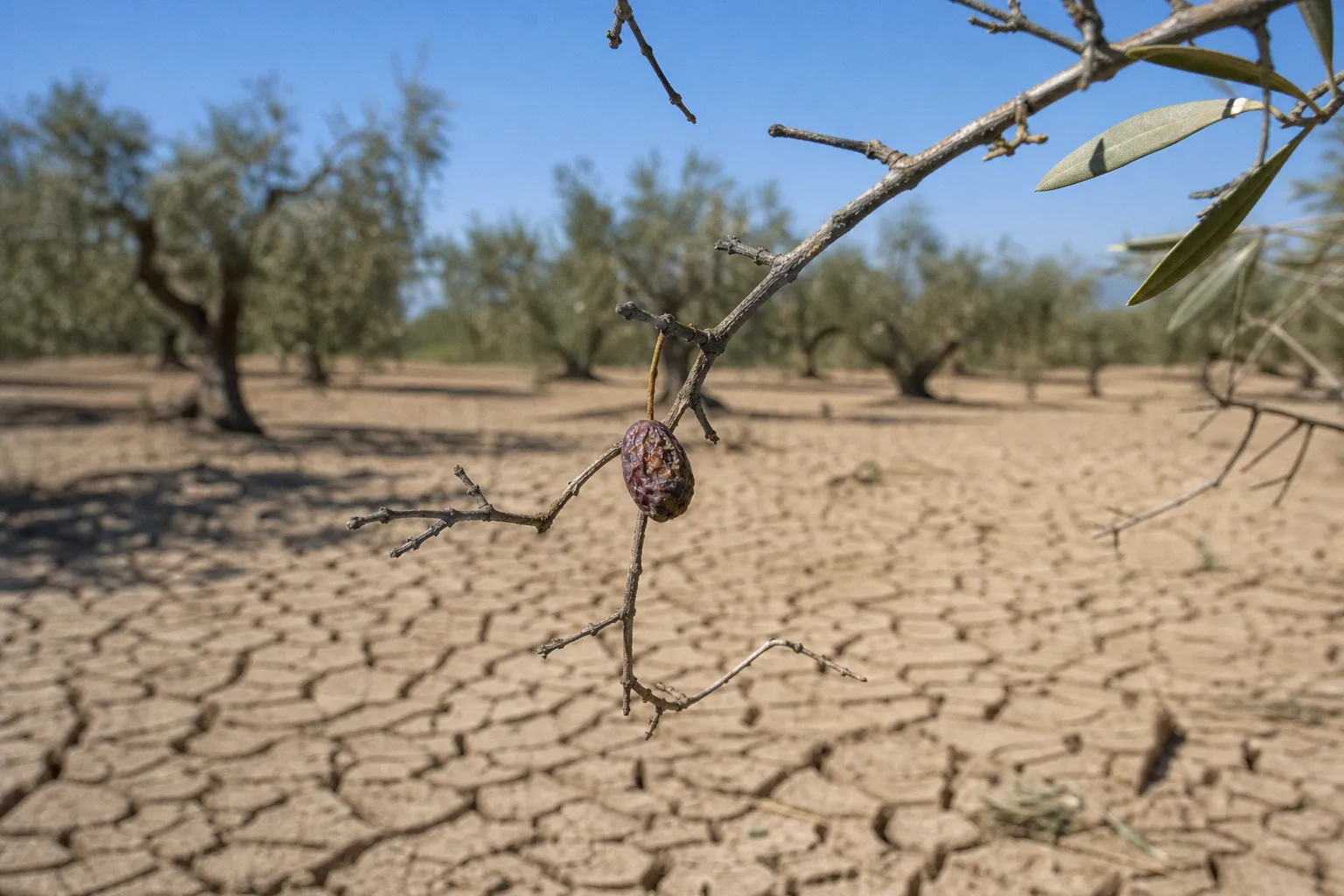
The Spanish agriculture ministry linked the shortfall directly to prolonged drought and high temperatures. Before the season concluded, the same ministry had forecast 780,000 tonnes; severe summer drought across the principal producing regions had already compromised fruit set, and the final number undershot even that revised expectation by more than 100,000 tonnes. The gap between plan and outcome is, in itself, a data point: it quantifies the speed at which climate volatility can override agricultural forecasting.
The olive case has become a useful lens for examining climate change effects in agriculture, and for a specific reason. The crop is, by agronomic consensus, drought-tolerant. Its inclusion in Mediterranean dryland systems for centuries rests on that tolerance. And yet, in the space of a single season, the entire Spanish harvest contracted by more than half. That contradiction is the entry point for a more careful systems-level analysis of where, exactly, climate risk enters agricultural production, and where the boundaries of adaptation lie.
The 2022/23 harvest: a case study in climate volatility
The mechanics of the Spanish collapse were not mysterious. Water stress during the summer and early autumn — the period when olive flower induction occurs — reduces flowering in the following spring. Severe drought can also damage xylem transport capacity, with effects that persist beyond the drought episode itself. Both processes were present in 2022. Maximum temperatures exceeded thresholds at which yield performance begins to be constrained; cumulative rainfall fell well below the levels that even a drought-tolerant species requires to sustain reproductive output. The result was a textbook instance of crop yield volatility: not a gradual decline in productive capacity, but a single-season discontinuity driven by the convergence of heat and water stress at the wrong phenological moment.
This distinction matters. Olive trees can survive arid conditions for years; what they cannot do, without penalty, is complete the reproductive cycle when those arid conditions arrive at the wrong developmental stage. The 2022/23 harvest was, in this sense, less a failure of the olive as a species than a failure of the climate to remain within the envelope the olive requires. The drought did not kill the trees. It starved the reproductive process of the inputs it depends on, at the precise windows those inputs are needed.
A crop's drought tolerance is a property of its mature vegetative state, not of its reproductive calendar.
Physiological limits: where the system actually breaks
The agronomic literature on Mediterranean olive cultivation identifies several concrete thresholds that frame the system's sensitivity. Annual precipitation below approximately 350 mm is treated as a limiting factor on olive distribution in arid zones, despite the crop's drought tolerance. Yield performance begins to be constrained when maximum summer temperatures exceed roughly 30°C, and photosynthetic rate is affected above 40°C. Optimum conditions for current Mediterranean growing areas cluster around a January monthly mean of about 7°C and a July monthly mean of about 25°C.
These figures are not universal legal standards. They are agronomic indicators derived from cultivar, soil, and orchard-system averages, and they vary across regions and management regimes. But they are useful precisely because they are quantitative: they give us a coordinate system in which to locate climate change effects in agriculture as they actually operate — not as abstract risks, but as movements of temperature and precipitation across identifiable physiological boundaries. The reproduction cycle is the critical exposure. Water stress during flower induction reduces flowering the following year. During flowering itself, stress triggers flower abortion and cluster abscission. During fruit set, it reduces the number of fruits that successfully establish. At each stage, the system has a different sensitivity profile, but the directionality is consistent: when heat and drought compress the reproductive window, output contracts. The Spanish 2022/23 outcome sits cleanly inside this mechanistic chain.
Distinguishing signal from noise: the attribution problem
A poor olive harvest, however, is not automatically evidence of climate change. Olive yields exhibit biennial or alternate bearing — a natural cycle in which high-yield and low-yield years alternate. The 2022/23 Spanish campaign fell on a low-yield point in that cycle. Any honest analysis of climate change effects in agriculture has to separate two questions: did climate make the harvest worse than it would otherwise have been, and is climate shifting the baseline around which the natural cycle oscillates?
The first question is partially answerable. Official Spanish data and meteorological records establish that drought and heat were extreme during the relevant phenological windows. The second is harder. No available source quantifies what share of the 2022/23 shortfall was caused specifically by anthropogenic climate change rather than natural variability, alternate bearing, irrigation constraints, pests, or management decisions. To claim that climate change alone caused the collapse would overstate the evidence. To claim that climate change had nothing to do with it would ignore the convergence of conditions that made the year structurally abnormal.
The IPCC's regional assessment is, on this point, deliberately calibrated. It assesses with medium confidence that agricultural and ecological drought has increased in the Mediterranean region, and with medium confidence that anthropogenic drivers have contributed to that increase. It also reports high confidence that warming and precipitation changes since 1990 have shifted European agro-climatic zones northward and advanced the growing season. These are not statements about a single harvest. They are statements about a moving baseline against which any individual year's outcome must now be interpreted — and against which crop yield volatility in the region is being slowly amplified.
We are not watching a single bad season. We are watching the distribution of possible seasons shift beneath the system.
The limits of adaptation: irrigation, water scarcity, and future yields
If the physiological problem is heat and water stress, the intuitive adaptation is irrigation. The evidence on this point is more constrained than the rhetoric suggests. A modelling study for Alentejo, Portugal projected olive-yield decreases of 15–20% by 2080 under both RCP4.5 and RCP8.5 pathways, driven by greater heat and water stress. In that model, targeted irrigation maintained yields near present values — but required 60–85 mm of additional water per season, and could itself be constrained by water scarcity. Irrigation, in other words, is not a free adaptation. It is a substitution: heat and water stress on the crop are replaced by water demand on the surrounding system.
This is the structural friction at the heart of agricultural adaptation strategies under climate change. The same warming that degrades crop physiology increases the hydrological demand of any compensating irrigation. In a region already classified as a hotspot for agricultural and ecological drought, that trade-off is not theoretical. Adaptation strategies that assume water will be available at the margin are assuming the absence of the very constraint they are meant to relieve. Soil degradation data from repeated drought cycles points in the same direction: when vegetative cover fails and irrigation is insufficient, organic matter declines, structure deteriorates, and the system's capacity to retain whatever moisture does arrive weakens further. The feedback loop compounds rather than resolves.
Beyond the crisis: global production and food system resilience
The temptation, in interpreting the Spanish case, is to extrapolate a permanent global decline. The data do not support that read. The International Olive Council reported global olive-oil production of 2,589,000 tonnes in 2023/24, followed by provisional production of 3,572,000 tonnes in 2024/25 and an estimated 3,440,000 tonnes for 2025/26. The trajectory is not monotonic. It is volatile — but the volatility operates around a level that recovers substantially after the 2022/23 shock. Global output did not collapse; Spanish output did, in a single season, before partial recovery in subsequent campaigns.
This is the systems-level lesson the olive case actually delivers. Climate change effects in agriculture do not arrive as a smooth downward slope. They arrive as discrete shocks — bad seasons, broken forecasts, regional collapses — superimposed on a baseline that itself is shifting. Food supply chain resilience depends not on the absence of such shocks but on the system's capacity to absorb them without cascading failure. A single country's bad year, in a globally diversified supply, is recoverable. The same shock, repeated across multiple producers in the same climate region in the same season, is not. And the probability of correlated shocks — of multiple Mediterranean producers hitting the same physiological ceiling in the same year — rises as the climate envelope that once differentiated their seasons continues to compress.
The structural takeaway
The olive oil story is not a parable about a fragile crop. Olives remain among the most climate-resilient tree crops in Mediterranean agriculture, capable of surviving conditions that would eliminate less adapted species. The 2022/23 collapse is a parable about the difference between tolerance and adequacy: a system can survive a changed climate and still fail to perform within it. The thresholds identified in the agronomic literature — 350 mm of annual precipitation, 30°C maximum summer temperatures, 40°C as a photosynthetic ceiling — are not lines a plant crosses and dies. They are lines a plant crosses and underperforms. Agricultural systems built on the assumption that historical climate envelopes will persist are not built for underperformance. They are built for a narrower outcome distribution than the one climate change is now delivering, and the variance around the mean is doing most of the damage.
What the Spanish case demonstrates, with unusual clarity, is that the cost of misreading that distribution is concentrated in single seasons and in the physiological windows that determine them. Adaptation strategies that focus only on long-term averages will miss the volatility that is already doing the structural work. Extreme weather farming impact is no longer a tail-risk scenario to be planned around; it is the operating environment. The lesson is not that olive oil is in permanent crisis. The lesson is that the categories we use to evaluate agricultural risk — tolerance, resilience, viability, even drought resistance — need to be recalibrated against a climate that is no longer behaving as a stationary background variable. The orchards are still standing. The harvest, when it fails by half, is what tells us the system has already moved.