From Resolution to Reality: Why Implementation Defines the Credibility of the United Nations
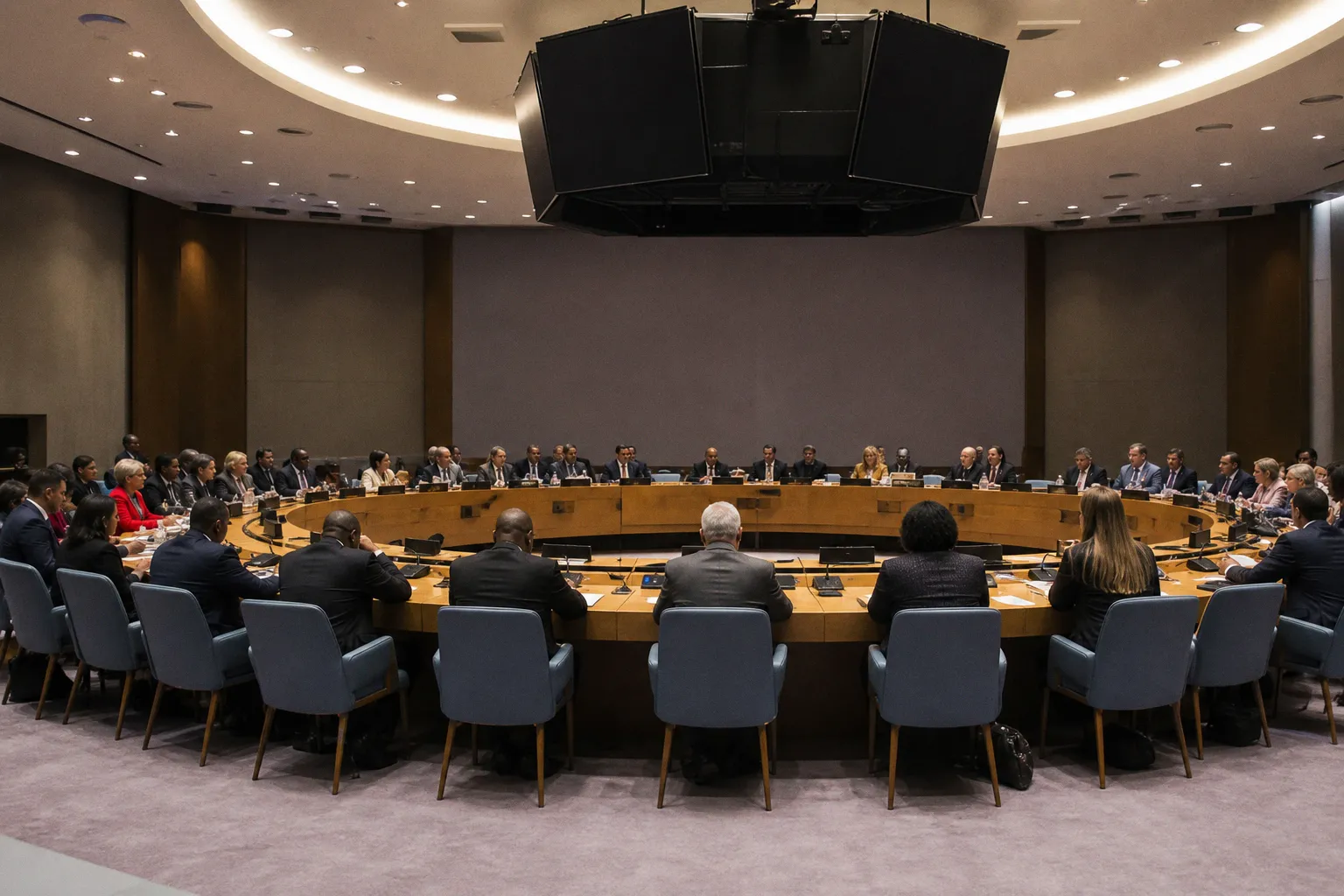
The 23 June 2026 Arria-Formula Meeting of the UN Security Council placed 36 member states around a single structural problem: resolutions adopted by the Council but left unimplemented.
Xavier Pennington, Lead Columnist, Systems & Macro-Trends·updated July 02, 2026
The Implementation Gap
Article 25 of the UN Charter binds member states to accept and carry out Council decisions. Article 2(2) requires Charter obligations to be fulfilled in good faith. Both provisions functioned as repeated reference points across the debate, held in New York and co-chaired by Ambassador Fu Chong of China and Ambassador Asim Iftikhar of Pakistan. Fu warned that ineffective implementation erodes Council authority and accelerates worsening crises. Assistant Secretary-General Khaled Khiari added a precise diagnosis: selective application weakens multilateralism, respect for international law, and conflict-prevention. Shamala Kandiah Thompson of Security Council Report reframed the effectiveness metric — resolutions should be judged by whether they achieve their intended objectives, not by adoption counts. Richard Gowan of the International Crisis Group delivered the bluntest reading: many states now operate on the assumption that Council decisions and broader international law can be ignored with impunity.
The roster of speakers cut across the geopolitical map — France, Denmark, the United States, the United Kingdom, Russia, the European Union, Qatar, Japan, Saudi Arabia, Nepal, Panama, Liberia, Greece, Colombia, DRC, Switzerland, Angola, Mexico, Oman, Zimbabwe, Azerbaijan, Australia, Algeria, Lebanon, Morocco, Cuba, Cambodia, Liechtenstein, Serbia, Venezuela, Latvia, Iran, Bahrain, and Somalia. The wording varied. The conclusion did not. Iftikhar used the floor to identify Jammu and Kashmir as a longstanding, concrete case of non-implementation — a working example of the abstract failure the meeting was convened to diagnose.
Institutional Authority and the Generational Cost
The implementation crisis at the UN is not an isolated friction. It plugs into a wider structural pattern: sustained erosion of trust in institutions, and a widening gap between those who make decisions and those who will live longest with the consequences. Nearly half the world's population is under 30, yet political leadership across most systems remains overwhelmingly concentrated among older cohorts. Electoral timelines, budget cycles, and institutional mandates operate on short horizons. Climate impacts, demographic change, and technological transformation unfold over decades.
The coupling is direct. Youth-led protests across multiple countries, falling confidence in institutions in global trust surveys, and the now widespread expectation that today's children will grow up worse off than their parents are not separate phenomena. They are structural correlates of governance systems whose decision cycles compress while the exposure they generate accumulates. When the Security Council passes resolutions that go unenforced, the signal to younger cohorts is unambiguous — the formal architecture of global governance produces text, not outcomes.
What to Watch
Three indicators will reveal whether 23 June becomes precedent or theater:
1. Follow-up mechanics. Does the Council establish any standing review of implementation status, or does the session remain an isolated stocktake?
2. Selectivity patterns. Whether permanent members continue treating enforcement as optional for resolutions they consider peripheral while pressing it for priorities they own — that asymmetry is what gave the Gowan assessment its weight.
3. The next Arria invocation. If non-implementation in an active file becomes the subject of a follow-up meeting within six months, the consensus hardens. If not, the Arria formula returns to its default function as a talking shop.
The deeper test sits at the generational level. The UN, like most governance architectures today, must resolve whether its authority structures produce outcomes proportional to the exposure they impose on those least represented in the rooms where decisions are made. The 36 speakers answered that question in principle on 23 June. The answer in practice has not yet arrived.