Xavier Pennington, Lead Columnist, Systems & Macro-Trends
July 22, 2026 · 9 min read
Future space exploration missions: Mars simulation lessons
In a 1,700-square-foot 3D-printed structure at NASA's Johnson Space Center, four individuals entered on June 25, 2023, and did not exit for 378 days. The habitat—Mars Dune Alpha—was not designed for comfort.
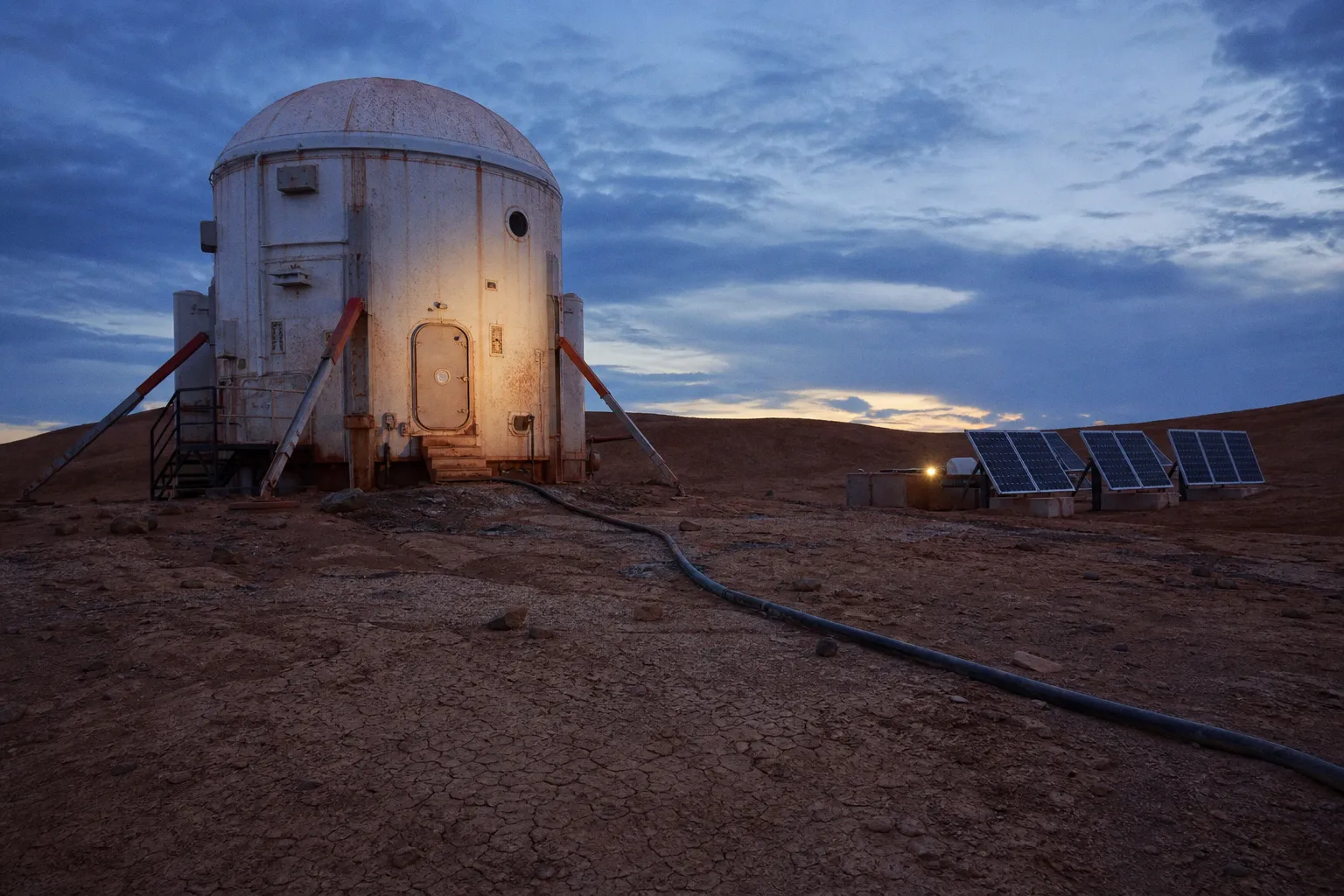
It was engineered to compress the operational constraints of a Martian surface mission into a terrestrial testbed: 22-minute one-way communication latency, closed-loop resource budgets, simulated equipment failures, crop cultivation cycles, and VR-anchored extravehicular activity. The data emerging from this and parallel analogs is now reshaping how engineers, flight surgeons, and mission planners architect the next generation of crewed Mars missions.
The core finding is not a surprise. It is a structural confirmation. Isolation at mission duration does not degrade crew performance uniformly. It degrades it along specific, predictable fault lines—sleep architecture, motor activity, and the communication link itself. Each fault line carries cascading effects that propagate into operational autonomy, crew-ground relationships, and the fundamental question of whether Earth-bound simulation can substitute for the un-simulatable hazards of deep space.
The Architecture of Isolation: Inside Mars Dune Alpha
Mars Dune Alpha occupies roughly 158 square meters. Divided across individual sleep quarters, communal workstations, exercise stations, and a crop-growth module, the habitat forces four crew members into continuous proximity for 378 consecutive days. Private quarters measure just enough for a bed and minimal personal storage. The constraint is deliberate. Mission designers calculated the spatial envelope from the volumetric requirements of a pressurized surface habitat that must be launched and landed within current heavy-lift constraints—not from comfort metrics.
The simulation layer is what separates CHAPEA from a generic long-duration lockdown experiment. Crews operate under a 22-minute one-way delay—44 minutes roundtrip—mirroring the maximum Earth-Mars light-time lag at superior conjunction. They execute simulated spacewalks through VR interfaces mounted on treadmills, manage crop cycles for tomatoes and peppers, and respond to injected equipment failures and environmental anomalies. Resource consumption—water, food, power—is tracked against closed-loop targets. Every parameter pushes the crew toward a single operational mode: problem-solving without immediate recourse to ground support.
A habitat at this scale is not a home. It is a closed thermodynamic system with humans inside it.
This architecture produces a controlled stress profile. The crew cannot escape. They cannot summon ground intervention in real time. They cannot externalize any function—whether cognitive, mechanical, or agricultural. The 378-day duration is calibrated to overlap with a realistic Mars conjunction-class mission profile: outbound transit, surface operations, and return transit compressed into one continuous isolation window. What CHAPEA tests, in effect, is whether the human-system can hold its operational coherence across that envelope.
Communication Latency and the Psychology of Detachment
The 22-minute one-way delay is the simulation's most consequential variable. It converts Mission Control from a real-time command authority into a delayed-patchwork advisor. Questions raised by the crew cannot receive answers within a single shift. Anomalies must be triaged locally. Decisions become irreversible before ground review is possible.
Data from the SIRIUS isolation project—a series of Russia-led analog missions—confirms what the delay structurally predicts: isolated crews operating under communication latency progressively decrease their overall communication volume with Mission Control. The phenomenon is documented in the literature as detachment. It is not disengagement in the psychological sense. It is an operational adaptation. Crews shift toward autonomous decision-making because the latency makes anything else inefficient.
The implications extend well beyond procedural efficiency. When crews reduce communication, ground loses visibility into crew state—both physiological and cognitive. Flight surgeons lose the granularity of real-time biomedical telemetry review. Engineers lose the informal channel through which anomalies are diagnosed collaboratively. The feedback loop that sustains crew-ground operational coherence weakens, and with it the capacity for ground to intervene before a small deviation compounds into a mission-level failure.
For future crewed Mars missions, this produces a non-negotiable design constraint: the ground segment must be architected for asynchronous operation. Real-time mission control architectures optimized for low-Earth orbit and lunar operations will not scale. The shift requires new tooling—delayed-communication decision protocols, predictive analytics that surface crew-state anomalies before ground review, and explicit cultural acceptance that the crew, not Mission Control, owns in-situ problem resolution. We are, in effect, redesigning command authority for a regime where ground cannot command.
Circadian Disruption and the Physical Cost of Confinement
The 520-day Mars-500 isolation experiment, conducted jointly by IBMP and ESA between June 2010 and November 2011, produced the most cited dataset on long-duration confinement physiology. Six crew members entered; four emerged with documented circadian misalignment or chronic sleep deprivation. The pattern was not random. It tracked confinement duration, with disruption accumulating measurably in the second half of the mission.
The second major finding was progressive hypokinesis—the measurable reduction in physical movement over time. Crew members did not maintain constant baseline activity levels despite prescribed countermeasures. They moved less as the mission extended. The reduction was not uniform across all crew, but the population-level signal was clear: extended isolation drives motor output down, and standard exercise protocols do not fully offset the decline.
For crewed Mars missions, the structural risk is twofold. First, circadian disruption degrades cognitive performance during the highest-stakes operational windows—surface EVAs, docking sequences, ascent. Second, hypokinesis in a 0.38g environment may compound differently than in 1g. Mars-500 establishes what happens on the ground; the Mars-specific multiplier remains unknown. Mission planners must therefore treat sleep architecture and motor maintenance as primary countermeasure domains, not secondary health priorities. Countermeasure design—structured light exposure, pharmacological aids, prescribed exercise—will likely consume a larger share of the Mars mission architecture than current ISS operations, and likely a larger share than current budgets assume.
The Limits of Earth-Bound Simulation: Radiation and Gravity
| Analog | Duration | Crew Size | Primary Constraint Tested | Critical Hazard Absent |
|---|---|---|---|---|
| CHAPEA Mission 1 | 378 days | 4 | Resource management, simulated EVA, crop cycles | Galactic cosmic radiation, 0.38g partial gravity |
| CHAPEA Mission 2 | 378 days | 4 | Solar conjunction blackout (2 weeks), operational autonomy | Galactic cosmic radiation, 0.38g partial gravity |
| Mars-500 | 520 days | 6 | Long-duration confinement, circadian stability | Galactic cosmic radiation, 0.38g partial gravity |
| SIRIUS series | 8–240 days | 3–6 | Communication latency, crew-ground detachment | Galactic cosmic radiation, 0.38g partial gravity |
| HI-SEAS | 4–12 months | 6 | Geological field operations, crew cohesion | Galactic cosmic radiation, 0.38g partial gravity |
The table exposes the structural ceiling of every terrestrial Mars analog. Ground-based simulations cannot replicate the two physical hazards that will most directly determine crew survival on the Martian surface: galactic cosmic radiation and partial gravity at 0.38g. These are not abstract gaps. GCR exposure on a Mars-class mission is estimated to deliver a substantial fraction of career-dose limits to crew, with elevated lifetime cancer risk as the modeled outcome. Countermeasures—shielding design, pharmaceutical radioprotectants, crew rotation—remain constrained by mass budgets and in early-stage development.
Partial gravity compounds the uncertainty. The human body's sensorimotor and musculoskeletal systems evolved under 1g. Mars-500 and CHAPEA can document what happens under isolation in 1g, but they cannot document what happens to motor coordination, bone density, or fluid redistribution in 0.38g. The ISS provides partial insight on microgravity, but the dose-response curve between microgravity and partial gravity is not established. For a Mars surface mission of 500-plus days, this is a primary unknown—one that ground analogs are structurally incapable of resolving.
The honest framing: analogs inform the operational envelope. They do not substitute for the physics of deep space.
This does not invalidate the analog program. It bounds its predictive power. Engineers and mission planners must treat analog data as one input among several, with the understanding that the most consequential variables—radiation dose, partial-gravity adaptation—are absent from the dataset. The architecture for crewed Mars missions must therefore include in-situ biomedical monitoring that exceeds anything tested in analog environments, with the capacity to surface anomalies that ground-based protocols cannot anticipate.
Operational Autonomy: Preparing for the Solar Conjunction Blackout
CHAPEA Mission 2, which launched October 19, 2025, and is scheduled to conclude October 31, 2026, introduced a specific operational test absent from Mission 1: a simulated two-week solar conjunction loss-of-signal blackout. During this window, the crew operates with zero ground contact—no voice link, no data uplink, no real-time medical consultation. Every decision is local. Every anomaly is contained or escalated by the crew alone.
The solar conjunction is not a hypothetical scenario. When Mars passes behind the Sun from Earth's perspective, the solar corona disrupts radio communication for periods ranging from days to weeks. Any Mars mission architecture must plan for it. CHAPEA Mission 2's two-week blackout test is the first systematic attempt to measure crew performance and decision-making under total communication isolation within a Mars-class simulation envelope.
By May 7, 2026, the crew had reached its 200-day milestone inside Mars Dune Alpha. The full dataset will not be available until post-mission analysis completes—likely 2027 or later, and the comprehensive quantitative health and performance outputs remain unpublished at this stage. What we are testing, in the meantime, is whether autonomous crew operation can hold mission coherence across an extended blackout window. The design itself signals a directional shift regardless of the eventual results. Future space exploration missions must be architected around operational autonomy as a baseline condition, not a contingency. Crews must be trained, equipped, and procedurally authorized to act as the primary mission authority for extended windows, with ground occupying a support and review role rather than a command role.
The Structural Verdict
The data emerging from CHAPEA, Mars-500, SIRIUS, and HI-SEAS converges on a single structural finding: the binding constraint on future crewed Mars missions is not propulsion, not landing precision, not even life-support closure. It is the crew-ground interface under communication latency, combined with the biomedical baseline degradation that extended isolation produces. The 2030s—the decade NASA has targeted for potential crewed Mars missions—will require architectures designed around these constraints from first principles, not retrofitted from low-Earth-orbit operations.
Ground analogs provide the operational rehearsal. They do not provide the physics. The gap between what terrestrial simulations can measure and what a Mars-class mission will actually encounter remains the defining uncertainty of the program. Closing that gap—or at minimum, instrumenting the mission to surface unknowns in real time—will determine whether the next decade produces a sustainable Mars architecture or a sequence of costly surprises. The simulations have done their job. They have shown us where the structural fractures lie. What remains is the harder engineering problem: building systems robust enough to survive them.