How the EU Foreign Affairs Council Uses Strategic Coordination to Manage Global Security
According to the Council of the European Union, foreign ministers met to address Russia’s war of aggression against Ukraine alongside other pressing global-security issues.
Xavier Pennington, Lead Columnist, Systems & Macro-Trends·updated July 16, 2026
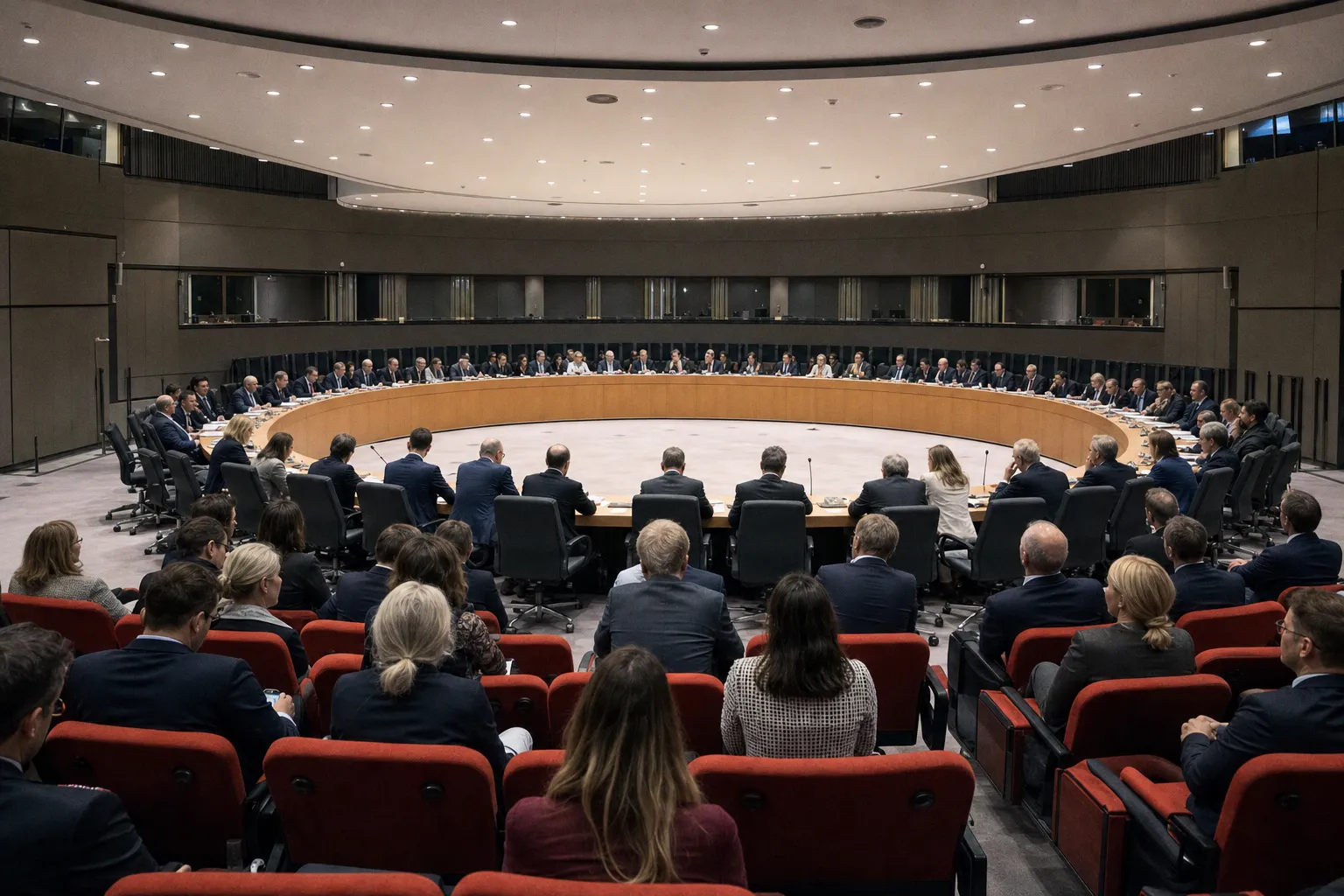
The formal purpose was coordination: aligning member states’ foreign-policy responses and security strategies. That sounds procedural. It is not. In a fragmented security environment, coordination is itself a strategic resource—and its absence becomes structural friction.
For readers watching European power, the useful signal is not simply that Ukraine remained on the agenda. It is that the Council framed the war and wider security questions within the same decision-making space. The EU is treating them as connected pressures on one policy system, rather than as isolated files.
Coordination is the mechanism
The Foreign Affairs Council does not erase differences among member states. Its relevance lies elsewhere: it is a venue for converting national positions into a more coherent external posture.
That creates a basic feedback loop. Security shocks generate national responses; those responses require coordination; the quality of that coordination determines whether the EU can act with strategic consistency. When alignment holds, the bloc has a clearer common position. When it does not, internal divergence becomes visible to every outside actor affected by European policy.
The Council’s emphasis on foreign-policy and security-strategy coordination therefore matters more than a generic meeting communiqué. It identifies the operating problem: common concern is insufficient unless it can be translated into compatible policy choices.
Ukraine remains a systems-level test
Russia’s war against Ukraine is not presented here as one issue among many. It remains the central stress test for Europe’s ability to sustain a shared foreign-policy response while managing other global-security demands.
That distinction is important. A foreign-policy system can absorb a single crisis more easily than several competing ones. Once priorities multiply, the risk is not necessarily a public break. More often, it is slower alignment, diluted attention and inconsistent signals—the incremental failures that reduce policy credibility before any formal disagreement is announced.
The Council’s agenda suggests that European ministers are working against precisely that dynamic. The task is to prevent wider security pressures from displacing coordination on Ukraine, while avoiding an approach that treats every other risk as secondary by default.
What to watch after the meeting
The immediate test is not the meeting itself but whether its coordination focus produces a sustained common line. Readers should track three things.
First, whether subsequent EU foreign-policy messaging on Ukraine remains consistent across member states. Second, whether security discussions continue to connect the war with broader global risks rather than segmenting them into separate bureaucratic tracks. Third, whether member-state coordination is visible in action as well as language.
The Council has confirmed the strategic frame: Ukraine and global security are being addressed together. The harder question lies downstream. Europe’s influence will depend less on the breadth of its agenda than on whether its members can keep that agenda politically and operationally coherent.