Xavier Pennington, Lead Columnist, Systems & Macro-Trends
July 16, 2026 · 14 min read
Current space exploration missions: the illusion of progress
On June 24, 2026, NASA’s Office of Inspector General put a number on a problem that had been visible for years: $5.9 billion in Artemis hardware contracts had been canceled or repurposed. Those contracts had originally been valued at $2.8 billion.
At nearly the same moment, Artemis II successfully completed its crewed lunar flyby launch on April 1 after earlier hydrogen-leak and helium-flow problems. Both facts can be true. Human beings are again flying around the Moon, and the architecture meant to sustain a return to its surface is being dismantled and rebuilt under budget pressure.
That is the central anomaly in current space exploration missions. Visible milestones continue to create the impression of linear progress. But the systems beneath them are accumulating structural friction: launch infrastructure that arrives years late, spacecraft designs dependent on unresolved propellant-transfer problems, and science programs whose cost profiles become politically indefensible before their scientific return can be realized.
The issue is not that exploration has stopped. It has become more selective, less coherent, and more vulnerable to cascading effects from a small number of bottlenecks.
Artemis has moved the landing target because the architecture could not hold
NASA’s February 2026 Artemis overhaul made the change explicit. Artemis III, once positioned as the first crewed lunar landing mission of the program, is now intended to become a low-Earth-orbit demonstration flight in 2027. The first landing objective has shifted to Artemis IV, currently targeted for early 2028.
This is more than a calendar adjustment. It changes the function of the missions.
A lunar landing mission integrates every difficult element at once: the Space Launch System, Orion, a lunar lander, mission operations, launch infrastructure, and the ability to coordinate complex operations far beyond low Earth orbit. A demonstration in low Earth orbit reduces that integration burden. It may still be useful. It may test operational procedures, crew systems, and elements of the broader flight stack. But it does not validate the lunar architecture in the environment where that architecture must ultimately work.
The shift therefore reveals a familiar pattern in large technical programs. When one subsystem becomes the dominant source of delay, the program redefines intermediate milestones so that activity can continue while the critical path remains unresolved.
| Mission role | Earlier Artemis framing | 2026 program structure |
|---|---|---|
| Artemis II | Crewed lunar flyby | Successfully launched April 1, 2026, after prior technical delays |
| Artemis III | First crewed lunar landing | Low-Earth-orbit demonstration mission, targeted for 2027 |
| Artemis IV | Follow-on lunar mission | Current target for the first crewed lunar landing, early 2028 |
| Lunar Gateway | Orbital staging and operations platform | Canceled in March 2026 |
| Surface presence | Long-term objective | Now receives greater strategic emphasis after the Gateway cancellation |
There is a rational argument behind this reordering. NASA cannot fly a sustainable lunar campaign by treating every mission as an all-or-nothing demonstration. A lower-risk mission can preserve operational momentum, retain workforce continuity, and expose problems before a landing attempt. The difficulty is that this logic also has a political feedback loop. A mission that succeeds in a less demanding configuration can be presented as evidence that the larger program is healthy, even if the actual landing sequence remains constrained by hardware and propulsion systems not yet proven at the required scale.
The distinction matters because public narratives tend to compress spaceflight into launches and destinations. A rocket leaving Earth is progress. A crew circling the Moon is progress. These statements are accurate but incomplete. The more consequential question is whether each successful mission reduces the uncertainty of the next mission on the critical path.
In 2026, the answer is mixed. Artemis II reduced some uncertainty around crewed lunar operations. It did not erase the constraints that pushed the landing target to Artemis IV.
A program can be active, visible, and technically impressive while its decisive capabilities remain deferred.
The $5.9 billion signal is not merely waste; it is an architecture problem
The largest financial warning from the 2026 audit is not the individual overrun. It is the concentration of overruns in the infrastructure that makes every subsequent mission dependent on earlier delivery.
The Exploration Upper Stage, or EUS, illustrates the problem. Boeing’s contract received a stop-work order in March after costs rose to nearly $2 billion. Projections indicated that a flight-ready unit would not arrive until late 2028, roughly 7.5 years behind schedule. The EUS was not a peripheral enhancement. It was intended to expand the SLS system’s capacity for more demanding lunar missions.
The Mobile Launcher 2 contract followed a similarly damaging trajectory. Its cost grew 314 percent, from $383 million to nearly $1.6 billion, before a stop-work order. A mobile launcher is not glamorous hardware. It does not produce lunar imagery or headline-grabbing science. Yet it is a fixed node in the launch system. If it slips, missions cannot simply route around it.
This is why large exploration programs are more fragile than their public budgets suggest. Their risk is not distributed evenly across hundreds of interchangeable components. It is concentrated in a handful of specialized assets with long development cycles, narrow supplier bases, and high integration complexity.
Three mechanisms made the problem self-reinforcing:
1. Late infrastructure multiplies downstream delay. A delayed upper stage or launcher does not affect one flight. It shifts test campaigns, launch windows, staffing plans, and contracts across the mission sequence. Each postponement creates secondary costs that do not appear in the original hardware estimate.
2. Cost growth reduces strategic flexibility. Once a project has consumed billions, canceling it becomes politically painful. But continuing it can consume funds needed for alternative designs, robotic science missions, or more mature commercial capabilities. The program starts optimizing for sunk-cost containment rather than mission value.
3. Repurposing hardware preserves activity but can obscure losses. Some canceled elements are reassigned, and some technical work remains useful. That is better than discarding every asset. Yet repurposing is not equivalent to delivering the initially promised capability. A contract should be assessed against the mission architecture it was supposed to enable, not merely whether some fraction of its engineering output finds a later use.
The $5.9 billion figure should therefore be read as a measure of structural friction. It captures the cost of plans that no longer fit the program’s operational reality.
There is a tendency to describe such outcomes as failures of management discipline. Management is part of the equation, but it is not the whole system. The Artemis architecture combines government-owned heavy-lift systems, legacy industrial contractors, commercial lander providers, deep-space operations, cryogenic technologies, and shifting congressional appropriations. Every layer has its own schedule, incentives, and risk tolerance. The interfaces between those layers are where delays compound.
This is not a defense of the overruns. It is an explanation for why they are so difficult to correct once they appear.
Mars Sample Return exposes the collision between scientific value and program economics
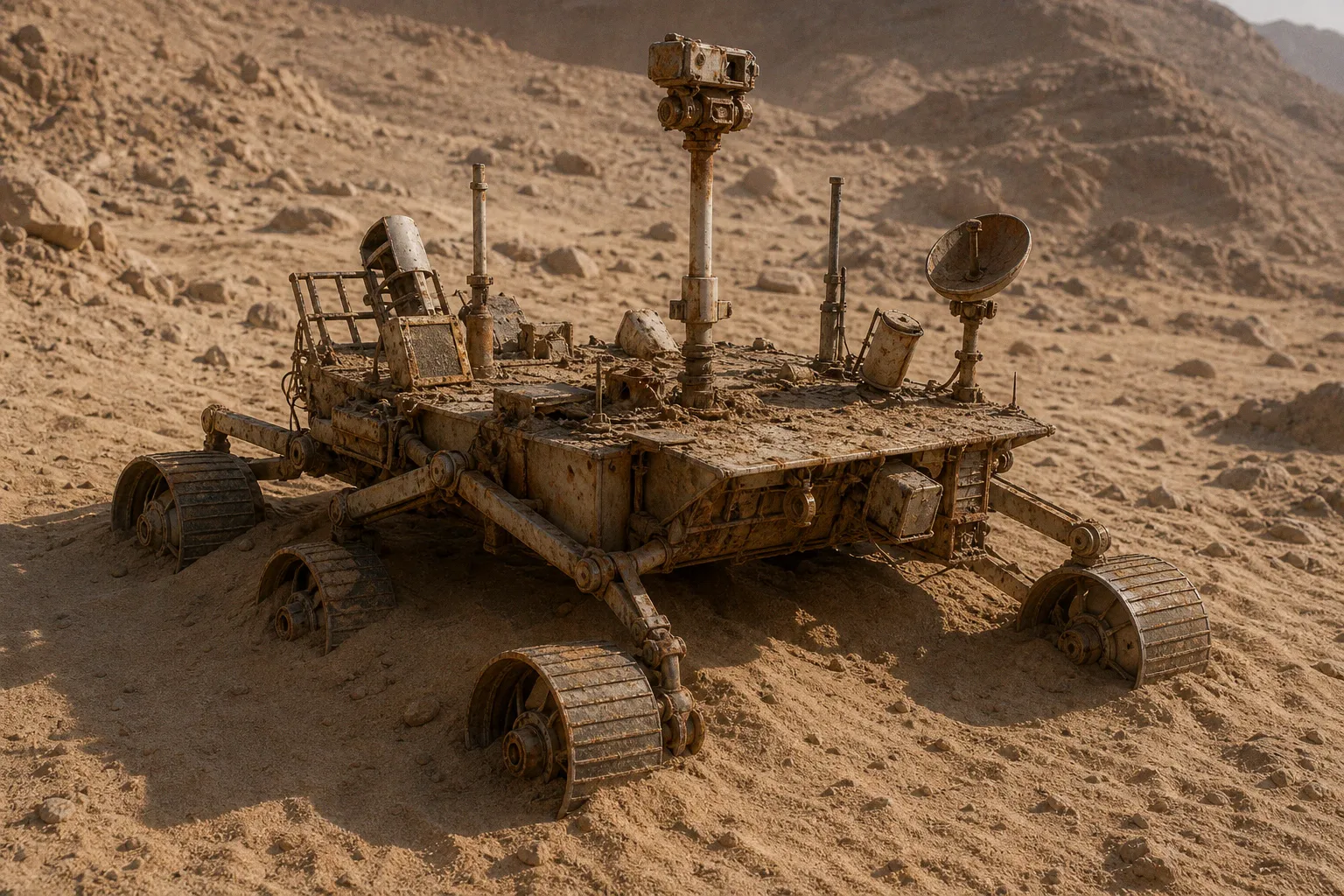
The Mars Sample Return mission faced an even sharper break. Its estimated lifetime cost had expanded to $11 billion before a House spending package on January 8, 2026 eliminated nearly all future funding. NASA is seeking scaled-down or commercial approaches, but the original program has effectively lost its financial foundation.
That outcome is especially consequential because Mars Sample Return is not simply another robotic entry in a robotic space missions list. It is a scientific infrastructure project.
The Perseverance rover has collected samples that could be examined with laboratory instruments far more capable than anything that can be sent to Mars. Sample return would enable repeated analysis over decades, allow independent teams to test competing interpretations, and preserve material for techniques that do not yet exist. That is a fundamentally different scientific proposition from transmitting data from an instrument mounted on a rover.
The scientific value is clear. The program economics became untenable.
This tension is often misunderstood. The cancellation pressure does not demonstrate that Mars science is unimportant. It demonstrates that high scientific value is not sufficient when a mission’s delivery architecture becomes too expensive, too slow, and too hard to explain within an annual appropriations process.
A mission estimated at $11 billion must survive several tests at once:
- It must show that no lower-cost architecture can secure a meaningful fraction of the science.
- It must maintain technical credibility across multiple election and budget cycles.
- It must compete with lunar exploration, Earth science, astronomy, planetary defense, and human-spaceflight commitments.
- It must persuade policymakers that the eventual return is worth paying for long before the samples arrive.
Mars Sample Return struggled most in the final category because its benefits are cumulative rather than theatrical. There is no single launch that resolves the narrative. The mission requires a chain: sample retrieval, ascent from Mars, rendezvous and containment, return transit, Earth entry, and secure laboratory handling. Each stage is defensible in isolation. Together, they create a cost and schedule profile with too many exposed interfaces.
The near-term consequence is obvious: a major scientific opportunity is delayed, narrowed, or transferred to a yet-unproven alternative model. The longer-term consequence is more serious. If flagship science missions are repeatedly permitted to mature into unaffordable architectures, agencies will retreat toward projects with shorter cycles and clearer political optics.
That would be a loss not because smaller missions lack merit. Many active space missions in 2026 deliver extraordinary value precisely because they are focused and bounded. The problem is portfolio imbalance. A scientific agency needs both: relatively fast missions that generate steady results, and a limited number of difficult undertakings that expand what can be known at all.
The scientific value of current space missions is not measured by launch cadence alone. It depends on whether difficult questions retain a viable path to instrument, sample, and evidence.
Canceling Gateway simplifies one problem and creates another
NASA officially canceled the Lunar Gateway station project in March 2026, redirecting focus toward a permanent lunar surface base. The decision has an internal logic. Gateway was an orbital station intended to support lunar operations, but it also represented another major system requiring modules, logistics, power, communications, propulsion, international coordination, and a sustained operational budget.
In a constrained budget environment, removing an orbital node can appear to simplify the architecture. Fewer vehicles. Fewer interfaces. Less duplicated infrastructure.
But simplification is not always reduction. Sometimes it is displacement.
Gateway was meant to provide an operational waypoint and a platform for particular lunar missions. A surface base, by contrast, requires durable power, mobility, habitat systems, surface logistics, communications, dust mitigation, and a recurring transportation chain. It shifts the center of gravity from cislunar operations to surface sustainment. That may better match the strategic objective of a long-term Moon presence. It does not make the engineering burden disappear.
The unresolved issue is sequencing. A lunar base is not a single mission product. It is the result of repeated delivery, construction, maintenance, and resupply operations. If the gateway architecture was expensive because it required persistent orbital infrastructure, a surface-base architecture will be demanding because it requires persistent surface infrastructure.
The key difference is where the bottleneck sits.
| Strategic model | Primary operational advantage | Core structural risk |
|---|---|---|
| Lunar Gateway | Supports cislunar staging and orbital operations | Adds a major infrastructure program before surface operations mature |
| Direct surface-base focus | Concentrates investment on the end-state capability | Requires reliable recurring lunar delivery and sustained surface systems |
| Short-term landing campaigns | Lower initial infrastructure commitment | Produces limited continuity and weakens the path to long-duration presence |
NASA’s pivot should not be treated as evidence that Gateway was inherently unnecessary. It is evidence that the agency has been forced to choose among expensive layers of an architecture that could not all be funded and delivered on the original schedule.
There is also an institutional question. Space programs often use intermediate infrastructure to stabilize international and industrial partnerships. A station creates recurring roles: modules, cargo flights, operations, research payloads, and technical standards. Removing that node may streamline the near-term budget, but it can alter the distribution of incentives among partners and contractors. The effects may emerge slowly, through reduced redundancy, fewer shared commitments, or a narrower coalition around the lunar program.
The phrase “permanent lunar base” therefore needs discipline. It describes a strategic destination, not an established technical capability or a settled implementation plan. The precise design and timeline remain uncertain. Treating the pivot as if it has already produced a credible surface system would repeat the same narrative error that has distorted the Artemis discussion: confusing announced direction with delivered capacity.
The 2028 landing depends on technologies that schedules cannot solve by decree
The early-2028 target for Artemis IV is now the focal date. It is also a date that rests on technical dependencies beyond NASA’s direct control.
Commercial lunar lander systems are central to the plan. SpaceX and Blue Origin are pursuing architectures that require sophisticated cryogenic propellant management and, in relevant mission concepts, in-space refueling. These are not marginal engineering details. Cryogenic propellants boil off over time. Transferring them between vehicles in space, managing thermal conditions, coordinating multiple launches, and demonstrating reliable long-duration operations are core requirements for large lunar landers.
The problem is not that these challenges are impossible. The problem is that their maturity must be demonstrated at operational scale, not inferred from component tests or optimistic schedules.
A 2028 lunar landing requires several linked conditions:
1. The lander must be ready in a flight configuration, not merely a prototype configuration. Deep-space human landing systems face performance, life-support, communications, navigation, and abort-related demands that cannot be fully simulated on the ground.
2. Propellant systems must work as an integrated operational chain. Launching fuel is not the same as storing it, transferring it, verifying it, and relying on it for a crewed descent and ascent sequence.
3. The launch and crew systems must align with lander readiness. A successful Orion mission cannot compensate for an unavailable lander; a lander demonstration cannot compensate for delayed launch infrastructure. The architecture succeeds only at the rate of its slowest critical subsystem.
4. Budget continuity must survive the remaining development period. Technical schedules are exposed to political schedules. A program that loses funding flexibility after a major overrun has less capacity to absorb the next surprise.
This is where current space exploration missions diverge sharply from the simpler public image of a new space race. Competition can be a catalyst. Commercial participation can reduce cost in some segments and accelerate iteration in others. But competition does not repeal systems engineering. The more the architecture depends on synchronized performance across independent organizations, the more aggressively interface risk must be managed.
The emerging model is not necessarily worse than the earlier, fully government-led approach. It is different. NASA is increasingly functioning as system architect, customer, regulator, and integrator rather than sole builder. That model can produce innovation. It can also make accountability diffuse when schedules slip. One provider can argue that launch infrastructure is late; another can point to changing requirements; the agency can cite appropriations. The system may have no single failure point, only a set of mutually reinforcing constraints.
That is why a target date should be treated as a planning instrument, not a fact about the future.
What remains real in the current mission landscape
The current picture is not one of retreat from space. It is a reallocation of ambition under technical and fiscal constraint.
Artemis II demonstrated that crewed lunar flight remains active. Robotic missions continue to generate planetary data. Commercial launch capacity is expanding. New launch vehicles, lunar landers, Earth-observation systems, and deep-space instruments are all moving through development and operations. The breadth of ongoing space exploration programs remains substantial.
But aggregate activity can conceal the weakening of a few high-value pathways.
The Moon program is being forced to choose between orbital infrastructure, launch hardware, lander development, and eventual surface operations. Mars Sample Return has shown how quickly a scientifically exceptional mission can become vulnerable when cost growth outpaces political tolerance. The Artemis audit has shown that contract value alone is not a measure of capability delivered. And the 2028 landing objective depends on technical demonstrations that remain consequential precisely because they have not yet been completed.
The productive interpretation of 2026 is not pessimism. It is calibration.
Exploration is not a sequence of announcements, launches, and commemorative images. It is a chain of capabilities. A chain becomes credible when its weakest links are funded, tested, and operationally connected. NASA still has the components of a lunar return strategy. What it lacks is the luxury of assuming that momentum will substitute for integration.
The illusion of progress begins when visible motion is mistaken for systemic readiness. The 2026 reality check is harsher and more useful: space exploration is advancing, but its most ambitious missions are now being decided less by aspiration than by the engineering, budgets, and institutional interfaces that determine whether aspiration can survive contact with hardware.