Russia’s military strategy appears to be shifting, here’s why it matters
The numbers tell the story before any analyst does. NATO committed more than $40 billion over five years to counter-drone systems at its Ankara summit, and Russia's own unmanned-systems forum…
Xavier Pennington, Lead Columnist, Systems & Macro-Trends·updated July 11, 2026
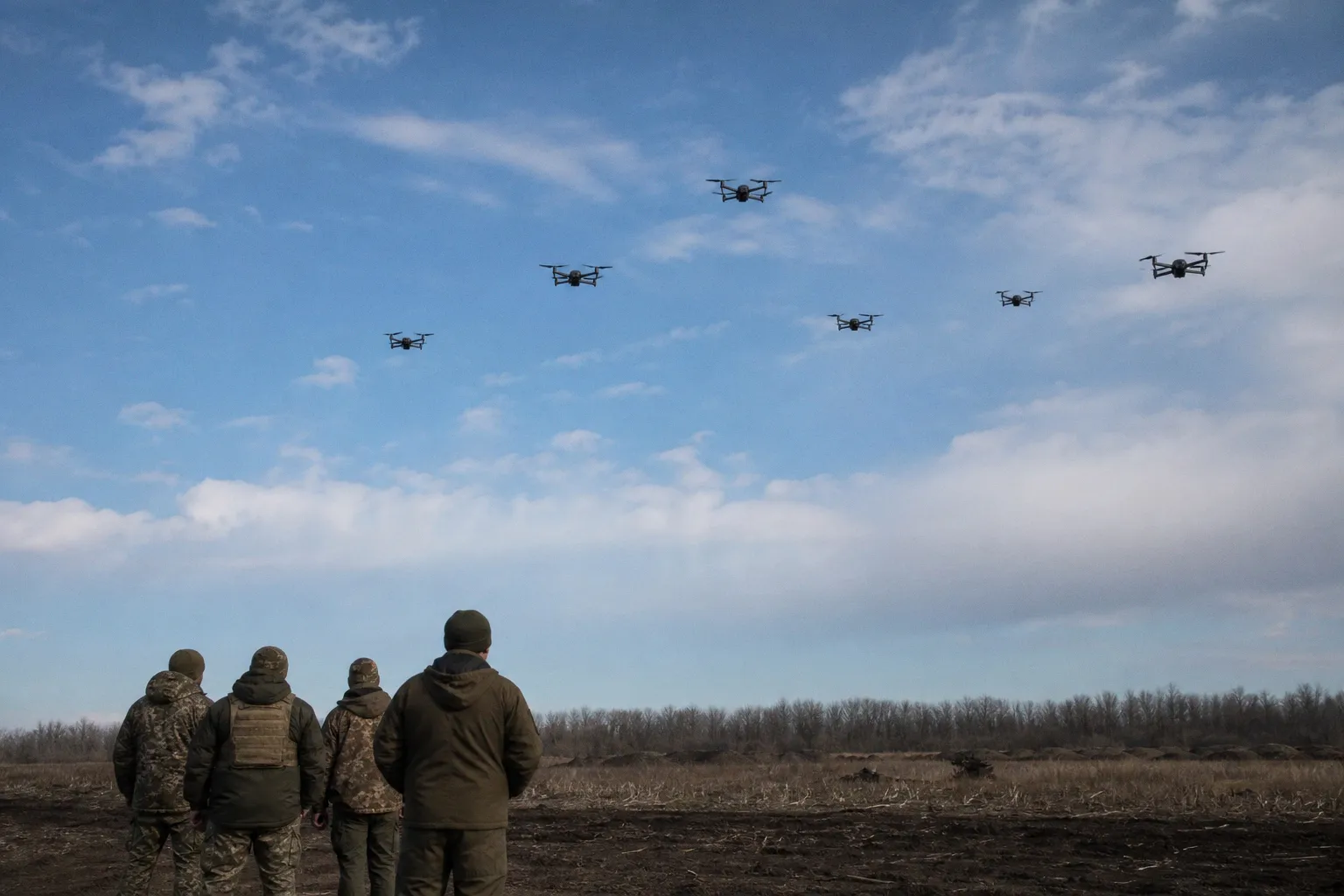
The numbers tell the story before any analyst does. NATO committed more than $40 billion over five years to counter-drone systems at its Ankara summit, and Russia's own unmanned-systems forum, Dronnitsa, is scheduled for August with preparation for a "big war with NATO" as its stated theme. The two curves are no longer parallel — they are interlocking, each side's procurement logic now accelerating in response to the other's stated intent. For anyone tracking the European security architecture, the drone edge has become the primary fault line worth mapping.
The NATO procurement cascade
The Alliance's "Drone Edge" initiative, unveiled in Ankara this week, formalizes what member states had been doing ad hoc for two years. Secretary General Mark Rutte additionally announced that Norway, Finland, Germany, and Denmark have signed a letter of intent to acquire up to five Northrop Grumman MQ-4C Triton high-altitude reconnaissance platforms. These will augment the existing RQ-4D Phoenix fleet operating from Sigonella Air Base in Sicily. Both airframes derive from the Global Hawk design — 35.4-meter wingspan, endurance beyond 30 hours — and their primary value is persistent ISR coverage rather than strike capacity. Equally consequential: NATO intends to quintuple its drone operator training capacity before the end of 2027. The signal here is straightforward. The bottleneck is no longer hardware. It is qualified personnel.
Russia's production pivot
On the other side of the line, the structural shift is in mass, not novelty. According to Samuel Bendett, an unmanned systems specialist advising both CNA and CNAS, Russian facilities currently manufacture millions of unmanned systems annually — a volume that provides, in his assessment, a temporary but tangible manufacturing superiority over Western counterparts. The most consequential technical line is fiber-optic controlled drones, which are substantially more resistant to electronic warfare than conventional RF-linked systems. That development did not emerge from a laboratory; it is a direct product of Ukrainian operational experience. Dronnitsa functions as the interface where field personnel, industry, and tactical doctrine converge, and this year's theme openly frames the next planning cycle as preparation for confrontation with the Alliance.
What the shift rewires
The strategic meaning sits not in any single platform but in a category transition. Unmanned systems are moving from ISR assets to primary combat systems — a shift already demonstrated by Ukrainian drone formations striking Russian petroleum infrastructure and by Iranian Shahed variants pressuring maritime traffic through the Strait of Hormuz. Cost asymmetry does the rest: modern kamikaze drones price far below conventional cruise missiles while enabling mass deployment, extended loiter, and engagement of mobile targets at low radar cross-section. NATO's own projections point to AI-coordinated swarm tactics, directed-energy interception, underwater-launched aerial vehicles, and additive manufacturing for munitions. Each item on that list compresses the decision cycle and raises the cost of deterrence. The Russian strategy is shifting because the offense-defense balance around unmanned systems is itself shifting — and both sides now know it.